Pages

Tuesday, September 19, 2006

We're All Geniuses Here

Jerome Weeks left his position as book critic for the Dallas Morning News rather than watch as the paper cut 111 jobs. He wrote a farewell column – which the paper declined to publish – which is a moving tribute to the written word. It also discusses the declining cultural importance of the novel.


The MacArthur Genius Awards were handed out yesterday. Somehow they missed me. But I was happy to hear that Adrian Nicole Blanc, a New York-based journalist who writes mostly about the poor and disenfranchised, won one of the $500,000 grants. She spent more than a decade following around a young woman her 2003 book, Random Family: Love, Drugs, Trouble and Coming of Age in the Bronx. The award is very encouraging. It’s a recognition that narrative non-fiction journalism is an art form, one that can illuminate social injustices.

Atul Gawande, a surgeon and New Yorker writer, George Saunders a short story writer and a Syracuse University professor, and David Macaulay, who wrote that wonderful illustrated book, The Way Things Work, also won awards.

Monday, September 18, 2006

New Cat Fight ... but this Time Between Men

This is probably the happiest day in Ed Champion’s life. Lev Grossman, the book critic for Time Magazine and a frequent target of Ed’s, wrote about their twisted, Internet-only relationship. The article’s title is “My Mortal Enemy.

“I do, however, have an archenemy,” Lev writes in the current issue of Time.

His name is Edward Champion, or at least I assume it is. That's the name he blogs under. I've never met him. I don't know what he looks like, how old he is, or pretty much anything about him (or her?). Except that every few months he calls me an idiot on his website.

Lev, take heart. It’s actually a compliment that Ed has noticed you. And it’s not really all that unusual to be called names by Ed. He does that to nearly everyone. It’s his schtick. He can be quite mean and catty. But he’s also very funny, and that’s why he gets away with it.

And it looks like this infusion of national recognition has made Ed so happy, he’s promising to tone down his invective.

Contrary to my criticisms, I don’t think Lev Grossman is a complete tool nor a total chickenhead…….In any event, as an olive branch to Lev, he’ll be getting something nice from me soon. And I will try in the future to paint less of a Manichean picture of the man.

Sunday, September 17, 2006

How to Write for The New Yorker

Cracking the top national magazine market is tough.

Editors at the New York Times Magazine, the Atlantic Monthly, Harper's, and The New Yorker are like soldiers under siege. Everyone wants access to them – their old college acquaintances, friends of friends, neighbors down the hall, even family members. Writers know that any personal connection to an editor at a top magazine, however tenuous, increases their chances of publishing an article in the magazine.

Some writers spend years trying to get published. John McPhee, for example, famously queried the New Yorker for more than 10 years before one of his stories was accepted. Now he contributes regularly.

“It’s a bunker,” according to Bill Wasik, an editor at Harper’s. “Getting inside the bunker is the hardest park. Once you’re in ….” His thought trailed off, but he clearly was suggesting that once you’ve written for one of these magazines, entrĂ©e anywhere else is much easier.

Penetrating the walls of the nation’s premier magazines was the topic of an unusual conference this weekend at the UC Berkeley School of Journalism. Titled “East Meets West,” the conference brought editors of elite publications together with 55 accomplished writers. The event was co-sponsored by the American Society of Journalists and Authors – itself difficult to join – so the writers in attendance all held impressive publishing credentials.

Still, the news was hard to hear.

“You don’t find the New Yorker; the New Yorker finds you,” said Dana Goodyear, a poet and writer who became an editor after working as David Remnick’s assistant for three years.

While some writers can find their way into the magazine by writing “Talk of the Town” pieces, those short articles focus mainly on New York so it is difficult for freelancers to find suitable topics, she said. But writing a number of them is one of the few ways to get assigned a larger piece

Many writers get their first New Yorker bylines when the magazine publishes an excerpt of their book. (What? I heard some members of the audience grumble. You have to write a book first and then hope a short section can appear in the magazine?)

Or you can write for smaller publications and hope you are noticed. That’s what happened to Elif Batuman, a graduate student in Comparative Literature at Stanford University. She wrote a few esoteric pieces for the new literary magazine N+1. Remnick read them, called her up, and invited her to New York to discuss ideas. She’s had two articles published so far in the New Yorker. Goodyear edited “Cool Heart,” a January 16, 2006 piece on the Thai kick-boxing trainer, Bunkerd Faphimal. Batuman’s voice and take on the subject was fresh and original – and that’s what the New Yorker is looking for, said Goodyear.

“Write for places where your voice can roam free,” suggested Goodyear.

Gerald Mazorati, the editor of the New York Times Magazine, suggested writers “know something really well and then know someone really well.” Find a topic that can become your specialty and give it a spin so unique that the top magazines can’t ignore your queries, he said.

The New York Times Magazine has about 30 writers under contract and only occasionally publishes work from writers outside its circle, said Mazorati. But it can be done. He suggested starting an e-mail correspondence with one of the magazine’s 8 assigning editors. Cultivate a relationship. Show them your work. Pitch them your ideas. With time, something might work out, he said.

The articles in Harpers, Atlantic, and Mother Jones are almost all written by free-lance writers. While each magazine has its own personality, the editors all crave well-written, unusual pitches. Bill Wasik at Harper’s said he likes “pitches with facts. Clunky, (meaning loaded with facts, not poorly written) detailed pitches.” Most new writers do shorter pieces to start. The editors have to known and trust a writer before they will assign them one of the longer articles that form the backbones of each magazine.

All the editors talked about the power of narrative. They want stories with a beginning, middle and an end, with well-developed characters. The New York Times Magazine needs article that are timely and linked to news events. The Atlantic specializes in big policy pieces. Harpers really prizes stories where reporters go undercover to expose a little-understood subculture.

While most magazine readers are women – and the women in the audience at the conference far outnumbered the men – most magazine articles are written by men. All of the editors said their magazines are not actively discriminating against female writers. They want more female writers. It’s just that most women write about issues central to their lives – marriage, parenthood, memoir -- and don’t do the big think pieces New York Times columnist Frank Rich calls the “bloviators.”

“We are a white male culture that may be intimidating to women,” said Scott Stossel, an editor at The Atlantic Monthly.

“It’s easier for women to sell an article on the sexy twist of work/life drama,” said Mother Jones co-editor Clara Jeffery. “It’s easier to sell. There are more magazines that would buy that rather than a big policy piece. There is a subtle way of steering women.”

If the editors were frank in suggesting that it is tough – although not impossible – to crack the top magazine markets, their appearances at Berkeley were encouraging in a less direct way. Without exception they were friendly and approachable and very human. Just hearing them talk about their magazines and the stories they are proud of stripped away some of the mystique of the New York publishing world. After all, somebody has to write those stories. And since when did saying “no” discourage any self-respecting reporter?

Monday, September 11, 2006

Profiles of the Rich and Famous

Call this the post of the profile. Here are three interesting stories about some of the most powerful (white) men in the news and publishing business.

The Guardian of London takes a look at David Remnick, the editor of The New Yorker.

New York Magazine looks at another powerful NewYork editor: Bill Keller, the executive editor of the New York Times.

A man with a different kind of power: Charles Frazier, who is about to release his second novel Thirteen Moons. He is so powerful that Random House paid him $8.5 million for the book, based on a one-page description. Scott Rudin chipped in another $3 million for film rights.

Saturday, September 09, 2006

Saturday Musings

The Contra Costa Times writes that the Chronicle may one day own a chunk of Dean Singleton’s Media News. This means one interlocking conglomerate could control all the newspapers in the Bay Area.

Scott Esposito on Conversational Reading has a nice essay about how his reading habits have changed now that he is a lit blogger.

Ilana DeBare of the San Francisco Chronicle looks at Cody's new owner.

Wednesday, September 06, 2006

Is There Really Just One Big Corporation Running All the Papers?

The Bay Guardian has always positioned itself as the scrappy underdog, the only San Francisco weekly to speak truth to power. For years it railed against monopolies that controlled the city's utilities.

The Bay Guardian is now looking at the recent consolidation of Bay Area newspapers and is once again yelling "monopoly." It is not only concerned that Dean Singleton owns the vast majority of the papers in the Bay Area, but is worried about the relationship between Hearst Corporation, the owner of the Chronicle, and Media News.

When McClatchy bought up Knight-Ridder it turned around and sold the San Jose Mercury News and Contra Costa Times and a batch of smaller papers to Media News. McClatchy then sold the Montery Herald and the St Paul Pioneer Dispatch to Hearst Corp, which turned over those papers to Media News in exchange for a large block of non-voting stock in Media News properties outside the Bay Area.

The Justice Department didn't find anything wrong with this. The only one who has stepped in to try and block the consolidation is Clint Reilly, a former political consultant. He is suing to prevent Hearst's takeover of Media News stock, arguing it would create a monopoly. A judge will hear the case in February.

Bruce Brugmann, the owner of the Bay Guardian, points out a delicious irony in his blog. The San Francisco Chronicle Magazine ran a lengthy narrative a few weeks ago about a newspaper war in Humboldt County between Singleton and an independent newspaper. But there has been very little written in the pages of the Chronicle about the impact of Dean Singleton on the Bay Area media scene.

"As you will remember from my last blog, I unveiled the term Eurekaism to replace the term Afghanistanism for the bad habit of many daily papers to cover stories in Eureka, but not the local big scandal or embarrassing stories in their hometowns," Brugmann wrote in his blog.

Japanese Firm Buys Cody's Books

Fred Ross, the owner of the two remaining Cody’s Bookstores, has sold his two-store chain to a Japanese buyer, Hiroshi Kagawa, the owner of Yohan, Inc.

"We are very excited about our partnership with Yohan as we begin our next half century," Ross said in a press release. "Yohan shares our commitment to independent bookselling. Working together we can extend our reach both locally and globally. Yohan's financial resources and international relationships will strengthen our existing operations, and will allow us to properly restock our shelves and offer the broad in-depth selection that customers expect from Cody's."

Cody's will essentially remain the same: a two-store operation that showcases numerous authors. Ross will remain as president and his wife Leslie Berkler will be vice-president in charge of store operations.

Yohan, Inc is the largest distributor of English-language books in Japan. It was founded in 1953 and currently operates 18 bookstores and a few publishers. Yohan bought Berkeley-based Stone Bridge Press last year. Kagawa is either 49 or 50 and "loves books," the press release quotes Peter Goodman, his long time friend as saying. ‘Yohan and Cody’s share a sensibility that venerates the written word.’”

The sale does not surprise to me. A few weeks ago I wrote about Cody’s financial problems. I had no details or statistics: I just noticed that the shelves in its Fourth Street Store in Berkeley didn’t have very many books on them. This was just weeks after Ross closed his wonderful Telegraph Avenue Store.

Ed Champion berates Ross for taking the easy way out. He suggests that Ross made a major miscalculation when he took over the old Planet Hollywood store on Stockton Street in San Francisco.

“But I know how you’ll justify all this, Mr. Ross. You didn’t sell out. You bought in. It was the “market,” after all, that killed off Cody’s. Not the fact that you took over Planet Hollywood’s old space on Stockton Street, which probably had a rent that was a shitload more expensive than the original Telegraph Avenue store that you so gracelessly killed. Fred Cody is spinning in his grave right around now. He never would have let this happen.”

I am sorry that the buyer is from another country. But ownership change can be good. Look, the Codys sold to Ross many years ago and he gave the community one of the best bookstores in the region. Maybe the new owner, Hiroshi Kagawa, will invest more money and refill all those shelves.

Saturday, September 02, 2006

R.I.P Jim Holliday

Jim Holliday, one of the best historians of California, died Aug. 31 in his home in Carmel at the age of 82.

I still remember reading The World Rushed In: The California Gold Rush Experience, Holliday’s opus on the California Gold Rush. It was history like no other history I had ever read.

The book is centered on the diaries of William Swain, a 28-year old man from Youngstown, New York, who traveled overland to California in 1849. Holliday uses Swain’s experiences to exemplify what happened when hundreds of thousands of people rushed into virgin territory and ripped out its insides. Holliday’s use of a personal narrative to describe a major social movement created a readable and accessible book of history. It’s a common technique now, but wasn’t as a popular in the 1980s.

J. S. Holliday stumbled on Swain’s journals shortly after he graduate from Yale in 1948. He met Edward Eberstadt, a New York rare book and manuscript dealer, who had Swain’s letters and journals from his daughter, Sara Sabrina Swain. Eberstadt had intended to publish the journals, but was prevented from doing so because of poor health and pressing business concerns. Holliday agreed to take over the project, little realizing it would take him 30 years to write The World Rushed In. But when the book was published in 1981 it became a best-seller and went through 13 printings.

I have just been using one of Holliday’s other books, Rush for Riches: Gold Fever and the Making of California, as source material for my own book. It’s an illustrated sort of coffee-table format book on California. It won the Los Angeles Times prize for best book on non-fiction in 2000.

Some of Holliday’s lectures are archived on the Bancroft Library site.

Thursday, August 31, 2006

Blogging in the summertime

I’m not the only blogger who has bowed out during the summer. The Wall Street Journal tells all:

“In the height of summer-holiday season, bloggers face the inevitable question: to blog on break or put the blog on a break? Fearing a decline in readership, some writers opt not to take vacations. Others keep posting while on location, to the chagrin of their families. Those brave enough to detach themselves from their keyboards for a few days must choose between leaving the site dormant or having someone blog-sit."

Wednesday, August 30, 2006

Newspaper Coverage in the Bay Area is Shrinking

The latest evidence of media consolidation in the Bay Area screamed out all over the front pages on Wednesday.

All of the major papers in the region prominently displayed the same story, the tale of a motorist who deliberately drove his black Honda Pilot into 14 pedestrians. He killed one man in Fremont and injured 13 others in San Francisco.

A month ago, the major papers – The San Francisco Chronicle, the San Jose Mercury News, the Contra Costa Times, and the Oakland Tribune – would have sent out a slew of their own reporters to cover the event.

But Dean Singleton’s Media News acquired the Mercury News and Contra Costa Times less than a month ago, creating a newspaper chain that circles the San Francisco Bay. Media News already owned the Oakland Tribune, the Argus, the Hayward Daily Review, the Marin Independent Journal and the San Mateo Times.

On Wednesday, instead of four distinct stories on the region’s front pages, there were only two – one from the Chronicle and one from the Media News group. (Reporters from the Mercury News did the story).

That’s a huge loss for Bay Area readers. Competition improves news coverage. What will readers miss out on in the future? This was just a police story; imagine the impact when the big story deals with corruption or another important, but less easily reported, event. If fewer reporters are tracking the story, there will be fewer revelations.

The irony is that the Chronicle is owned by Hearst Corporation, one of the world’s leading media companies. Now it looks like an independent voice fighting against the near-monopoly of Media News. How times have changed.

Tuesday, August 22, 2006

Osama Bin Laden and ..... Whitney Houston???

No one has ever suggested that Osama Bin Laden is kind or considerate. Now his former lover, the Sudanese writer Kola Boof, 37, has written a memoir, Diary of A Lost Girl, about her virtual imprisonment by the leader of Al Queda. Harpers Magazine is running an excerpt. Bin Laden was not only cruel to women, he apparently had a fixation on Whitney Houston.

“He would humiliate me by making me dance naked,” writes Boof. “It was such a strange thing, because for the most part he believed music was evil. If a guest at the estate played music, he would cover his ears until the “poison” was silenced. But other times he would become this devout party boy who wanted to hear Van Halen or some B-52's. To this day I hear the song “Rock Lobster” in my sleep. I would be jerking around like a white girl—“Dance like a Caucasoid girl!” he would say—and his eyes would track me from one side of the terrace to the other. “Your ass is too big, show me the front,” he said. Osama, you understand, did not know the difference between being vicious and being tender.”

And later on ….

“Osama kept coming back to Whitney Houston. He asked if I knew her personally when I lived in America. I told him I didn't. He said that he had a paramount desire for Whitney Houston, and although he claimed music was evil, he spoke of someday spending vast amounts of money to go to America and try to arrange a meeting with the superstar. It didn't seem impossible to me. He said he wanted to give Whitney Houston a mansion that he owned in a suburb of Khartoum. He explained to me that to possess Whitney he would be willing to break his color rule and make her one of his wives.”

Now this sounds like a strange and fascinating book. A look at Bin Laden's lechery.

Wednesday, August 09, 2006

Tidbits

This sale was just announced on Publisher’s Marketplace:

The mother of football player and soldier Pat Tillman, Mary Tillman and SF Chronicle deputy editor Narda Zacchino's untitled book about Mary's efforts to learn the truth surrounding the death of Pat, 27, while on patrol in Afghanistan -- which sparked six different Pentagon investigations -- also looking at his life, the meaning of patriotism, and the nature of sacrifice, to Ellen Archer and Will Schwalbe at Hyperion, with Leslie Wells editing, for publication in 2007, by Steve Wasserman at Kneerim & Williams.

The Chronicle has followed the Tillman story closely, doing a number of take-outs on his death, the role of friendly fire in combat, and the cover-up. Cynically I ask whether we need one more book on Bush’s deceits, but I think this will show just how far the Pentagon will go to sugar coat our wars.

SPEAKING of deceit. I saw the movie “Who Killed the Electric Car,” last night. It is an excellent documentary and I recommend that everyone see it. I had no idea. General Motors produced about 1,000 electric cars to comply with California’s strict emissions standards. They were zippy and problem free and those who drove them loved them.

California did away with its zero-emissions standards in 2003 under intense pressure from the car companies and George W. Bush’s government. Then GM rounded up all the cars (they were leased) and crushed them. It’s infuriating considering we are choking on our own smog, while people in the Middle East die because of oil.

Tuesday, August 08, 2006

Critical Mass, the blog of the National Book Critics Circle, has an interesting interview with Oscar Villalon, the editor of the San Francisco Chronicle's book review section.

Q: Are there any rules that guide how you sort through and pick the ones you'll review?

A: Self-published and vanity press stuff, of course, always gets tossed immediately. If a book is regional and its region has nothing to do with the Bay Area, that gets tossed. The first things I look at are: How pertinent is it to the region, and how pertinent would it be to our readers? We don't review romance novels. We do genres -- SciFi, mysteries and thrillers -- in monthly roundup columns, so those get set aside for that. Everything else I pretty much hang on to and flip through. Of course that's the other big chunk of my time -- going through those galleys and at least reading a little bit into them.

Choosing which books to review is completely subjective. You look at the catalogs and get a sense of what looks interesting, who you like. It's pretty much the same way you decide what you'll cover in a newspaper: You just go by your instincts. Clearly you pay attention to what's in the news and which books could be related to that, but for the most part, it's about picking books you would like to read. You have to trust your instincts and hope readers like to read what you're interested in. If your interests are too esoteric, you're going to alienate a lot of people, and if your interests are too broad, you're going to pique very few people. It's got to be somewhere in the middle.


Some summer books

It’s been a busy time for me this month. I am working hard on my book while I am free from other job and school-related distractions. One thing I have learned about writing a book: you can fiddle and rewrite endlessly. I have the sense that if I play around with my words enough, I can always make them better.

But I have been reading. Here are some thoughts:

Water for Elephants by Sara Gruen – This one sits atop the Chronicle’s best-seller list and was highly praised on its release. It’s an atmospheric book about a young man who joins a train circus in 1931. Gruen does an excellent job showing the bizarre and cruel world of the circus, where violence hides under the grin of the circus master. It’s a quick and enjoyable read. Nothing too deep or profound but fun.

The Dissident by Nell Freudenberger

Freudenberger is the author of the short-story collection Lucky Girls. She made one of those debuts people dream about – lots of praise in the New York Times and other august publications, long features with attractive photos. The Dissident is her debut novel and it is set in Los Angeles and Beijing. It’s really a novel about artiface and why we aren’t who we present ourselves as being. I think this theme – which actually took some guessing because of the cryptic nature of the plot – is stronger than the book. What? You ask. It means I didn’t love the plot or writing but when I thought about the book after I finished it I decided I enjoyed it.

Consuelo and Alva Vanderbilt: The Story of a Daughter and a Mother in the Gilded Age by Amanda MacKenzie Stuart.

This was a wonderful dual biography of the female Vanderbilts, but it goes way beyond descriptions of the decadent world of Newport society. Alva Vanderbilt was the woman who married her daughter Consuelo off to the Duke of Marlborough just to catapult her family into the social stratosphere. The book details that unhappy marriage and how Conseulo eventually overcame the stultifying British society to work for the downtrodden. Alva was a surprise, too, because she became an ardent suffragist and was critical in the fight for women to get the vote. There’s lots of great history and context, as well as glimpses into the world of the Gilded Age rich.

Archie and Amelie: Love and Madness in the Gilded Age by Donna M. Lucey

This is another dual biography of a Gilded Age couple, only these are Astors. Archie Chanler is the great great grandson of John Jacob Astor, but his life is anything but easy as his parents die at an early age. Archie meets and marries Amelie Rives of Virginia, who has written a racy bestseller about a taboo topic – the sexual yearnings of women. The marriage is a disaster from the beginning. Archie is eventually committed to an insane asylum by his siblings and the book does a good job exploring whether he really was crazy or his brothers and sisters were just spiteful. This is a good read but it has absolutely no historical context at all.

Thursday, August 03, 2006

Cody's Books is Still in Trouble

I thought Cody’s troubles would be over after they closed their famed store on Telegraph Avenue in Berkeley.

I am sorry to say they are not.

I went into their store on 4th Street today, in the tony shopping district in Berkeley, and was dismayed by what I saw.

The shelves looked bare.

Now Cody’s on Telegraph was the kind of place where you knew you could get almost any book, at any time. It was a place of surprises. You could walk in, browse any table in the store, and see something interesting. The shelves were crammed with books, the piles on the tables sometimes tottered over and the store had a feeling of abundance.

I didn’t get that feeling at the store on Fourth Street. There was an awful lot of maple showing, since most of the upper shelves were empty. The front table with the current releases had just had a few copies of some of the current bestsellers and the tables with the new fiction and non-fiction paperbacks had lots of space.

I had driven all away across town to go to this Cody’s. (The one on Telegraph was about 5 minutes from my house) I needed to look at some books for a journalism class I will be teaching this fall, but the store didn’t have the titles I wanted. (And these are recent non-fiction titles) Worst of all, the woman behind the information desk said she couldn’t order one of the books because Cody’s currently owes money to the distributor of that title!

“Didn’t you know we have money troubles?” she asked.

I did. I naively assumed that closing the Telegraph Store would take care of Cody’s problems. Apparently it hasn’t.

Did I help the store out by buying a book? Yes, I bought a paperback for $15. But I had been prepared to buy 4-5 books. They weren’t on the shelves.

Friday, July 28, 2006

Pine Lodge at Sugar Pine Point State Park

 Posted by Picasa

Summering at Lake Tahoe in the Gilded Age


This is where I’ll be the next few days. This is the house Isaias built, Isaias being the subject of the biography I am writing. Isaias Hellman was the president of the Nevada National Bank when he bought 2000 acres and two miles of shoreline on Lake Tahoe in 1897.

Lake Tahoe was not yet a popular tourist destination for people living in the Bay Area. It took about nine hours by overnight train to reach Truckee, and then travelers took a stage coach over a rocky road to reach Tahoe City. After 1900, they could take a narrow gauge rail line to the Lake, where they then had to board a steamer to get to a hotel or home. The roads weren’t very good then.

Isaias Hellman moved into this shingle style house in 1903. He was the first millionaire to construct a mansion on the lake. The tourist trade had only taken off in the 1880s and most wealthy people summered at one of the lake’s fancy hotels. Hellman and his family spent a few summers at Hotel Tallac on the southern part of Lake Tahoe. It was owned by Lucky Baldwin, who had made a fortune in the Comstock Lode, and it catered to the upper crust. Women changed their clothes four to five times a day, took strolls around the grounds and sat down to five course meals. There was great fishing – it was not uncommon to catch hundreds of pounds of trout in a few hours – and great boating.

Hellman fell in love with Lake Tahoe and quietly bought up land around Sugar Pine Point. He didn’t want to tip off speculators that he was in the market for a home. He built his house, using granite from nearby Meeks Bay and other local materials, from 1900-1903. It remained in his family until 1965 when it became part of the California State Parks System.

For the last few years a group of volunteers has put on a Living History Day at Sugar Pine Point. I am going up there to give some talks about Hellman and to revel in the sight of people dressed up in ‘30s period costume. It should be fun.

Saturday, July 22, 2006

Alison Bechdel


I’ve only read a couple graphic novels in my life. Maybe I’m choosing well, but I’ve found them to be much like any good novel, intriguing, engrossing, and imbued with emotions.

I loved Marjane Satrapi’sPersepolisseries about Iran and life as an exile in France. Somehow the comics enhanced the story of her adolescent confusion and burgeoning sexuality. They also made the scenes of oppression in Iran easier to take.

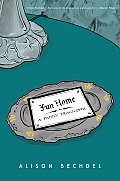
I’ve just read Alison Bechdel’s new graphic memoir, Fun Home: A Family Tragicomic, and think it works even better than Persepolis. Bechdel tells intertwining stories of her father, her mother and herself living in a rural town in Pennsylvania, and how they lived parallel, yet separate, lives.

The focus is on her father, who is a closeted homosexual. He finds joy in turning the family’s run-down Federal style farm house into a Victorian showcase, a place almost too ornate to be comfortable. He teaches English and runs the family’s undertaker business. Alison calls the funeral home the “Fun House.”

Alison, who is a lesbian, is “Spartan to my father’s Athenian, modern to his Victorian, Butch to his Nelly, utilitarian to his aesthete.” She spends much of her life defining herself in opposition to her father, until, ironically, he conveys his homosexuality to her a few weeks before he dies. (It’s officially an accident – he is hit by a truck – but Alison suspects he committed suicide.)

Blechdel is trying to understand her father’s life. Was it wasted because he could not publicly acknowledge who he was? Was he gay or bisexual? Did he ruin his wife’s life? Why did he keep so many secrets? Throughout the graphic novel, Bechdel tries to uncover her father’s motives, and the book is as much about her search for understanding as it is about his story.

The book is also built around themes in literature, as Bechdel and her father are avid readers. Blechdel uses Ulysses, by James Joyce, and The Odyssey, by Homer, to explore themes of connection, loss, and journey.

I gave this book to my 14-year old daughter before I read it, naively thinking that a graphic novel would be appropriate for a young reader. It’s not. There are explicit scenes of coupling and the literary illusions were too sophisticated for her to grasp completely. But I would highly recommend it to others.

Bechdel explains her book to the Village Voice and to the Powell's blog.

Wednesday, July 19, 2006

Different Kinds of Lost Boys

Samuel Garang Akau, one of the “Lost Boys of Sudan” read his first novel, Animal Farm, while a teenager in a refugee camp in Kenya. He had to share the book with 30 others. With two parents and a brother killed in sectarian violence, Akau found his way to Stanford’s English Department, where one of his short stories won a prize. He plans to write "at least four or five novels. And a memoir," he said. It will be "not my story alone, but the story of a lot of people."

The New York Times gives Toby Young’s new memoir, The Sound of No Hands Clapping, a thumbs up. Young may be one of the most conceited, self-centered, celebrity-gawking losers on the planet, but he sure writes funny.

Silence of the City is a new website devoted to printing rejected “Talk of the Town,” pieces from the New Yorker. Great name. I can see why some of the pieces never made it into the magazine.

Monday, July 17, 2006

The Making of a Biography

I was interested to read Michael Kazin’s review of The Most Famous Man in America, not only because Debby Applegate’s biography of Rev. Henry Ward Beecher seems so interesting. I have been waiting for this book to come out for more than four years, because of the hype it received in Susan Rabiner and Alfred Fortunato’s excellent book: Thinking Like Your Editor: How to Write Great Serious Nonfiction – and Get It Published.

The Rabiner and Fortunato book is the single best book I found on how to think about a book of serious non-fiction – the questions a book must pose and the narrative a book must follow. Most of the tomes on writing book proposals focus on “How-To” books, which wasn’t very helpful to me when I was thinking about writing a biography. I must have read Thinking Like Your Editor a half-dozen times while getting my own proposal together.

Rabiner is Applegate’s agent, and uses Applegate’s book proposal and a sample chapter as a central focus of the book. And from the early reviews the book has lived up to its hype. (By the way, the title original suggested for the book was Breach of Faith. I like that better than .)

JON CARROLL of the San Francisco Chronicle has a good column on book reading, collecting and reviewing.

The LitBlog Coop has recommended a new summer read: Michael Martone’sMichael Martone.” (I kid you not.)

Tin House, one of the hippest literary journals around, hosts an annual fiction conference each summer in Oregon. Here's a report on the goings on. (Via Elegant Varietion)