Pages

Tuesday, January 09, 2007

Vikram Chandra Hits Town

Vikram Chandra is descending on the Bay Area this week. But since he lives part-time in Berkeley, perhaps it’s more accurate to say he’s emerging from his Rockridge home into the bowels of bookstores around town.

Chandra is the author of the critically-acclaimed novel Sacred Games set in Mumbai, a 900+ page tome that almost everyone says is a page turner. He was profiled this week in both the Chronicle and Contra Costa Times. (Jonathan Yardley of the Washington Post doesn’t like it quite so much.)

Proof that he is hot? There are 26 holds on his book in the Berkeley Public Library System. (I’m at #10).

Chandra will speak at 7 pm tonight at Cody’s on Fourth Street. He will be at Book Passage in Corte Madera Thursday at 7 pm, and at various other spots.

Sunday, January 07, 2007

Death on the Page

Ericka Lutz, an Oakland writer and the granddaughter of Tillie Olsen, the author who died on New Year’s Day, has written a piece for Literary Mama about saying goodbye to her dying grandmother.

Apparently Calvin Trillin’s new book, About Alice, is a moving and loving tribute to his late wife, the subject of many of his essays. It originated as a New Yorker essay and is now a 96-page book. Lots of buzz about this one. People like it more than Joan Didion’s tribute to her late husband, Year of Magical Thinking


I looked at another book about dying a few days ago, although it’s not being marketed like that. It is Annie Leibovitz’s latest book and it’s called A Photographer’s Life, 1990-2005.

Leibovitz is best known for her celebrity portraits, like the ones she took of Demi Moore while pregnant or Whoopi Goldberg immersed in a tub of milk.

This book has some celebrity shots, too, but it’s much more personal. Though there are pictures of Leibovitz’s aging parents, the real heart of the book documents the life and death of Leibovitz’s long-time partner, Susan Sontag.

It’s amazing how Leibovitz coveys her devotion in only a few shots. The early parts of the book have numerous snapshots of Sontag in exotic locales – on the Nile River, in Mexico, in other places the pair traveled for work or pleasure. Leibovitz includes a few photos of the notes Sontag wrote for her novel, The Volcano Lover. There are also some shots of a naked Sontag asleep on a couch or in a bed, loosely covered by sheets.

The first hint of trouble comes from the photo of Sontag in the bathtub, one breast exposed, her hand covering the scar where her other breast had once been.

As Sontag was dying, Leibovitz took very few pictures. There is one where Sontag is in a hospital bed hooked up to IV with all sorts of tubes running in and out of her.

The next photos are of Sontag in a Seattle hospital after a bone marrow transfusion. Sontag’s trademark black hair with the white swath in the front is gone, replaced by white stubble. Her body is so bloated by medicine it’s not clear if she is a man or a woman. She is unrecognizable.

The next photo shows Sontag on a stretcher being lifted into a small plane. Then Leibovitz shows her dead, stretched out on a funeral platform. She doesn’t look anything like her old self. Her hair is short and white and she’s dressed in a silk loose gown. She’s nothing like the fierce Susan Sontag of the public imagination, dressed in black using her sharp wit to offer incisive observations about the culture.

I am surprised Leibovitz included these photos because they are so intimate and raw. They show a human being at her most vulnerable, just as she is about to face death. There’s nothing pretty here. But maybe that is Leibovitz’s point. She loves Sontag – when she is beautiful and when she is not.

Friday, January 05, 2007

Black Oak Books for Sale

Heidi Benson pointed out in today’s Chronicle that Black Oak Books has put itself up for sale. A fellow bookseller told me that their expansion into San Francisco was probably the culprit, as it’s hard to sustain two stores at once. Black Oak is one of those venerable Berkeley bookstores that has a great selection of new and used books and a lively events calendar featuring provocative authors. They also offer decent prices for used books. I am keeping my fingers crossed, but that hasn't helped in the past.


That news and the announcement that Advanced Marketing Systems has filed for bankruptcy is not a good way to start the New Year. AMS owns Publishers Group West, based in Berkeley, and that could mean a lot of local people lose their job. AMS is $200 million in debt to numerous publishers, including Random House and Simon & Schuster.

Publishing may be headed for a shakedown, just like the newspaper business. It’s only going to get uglier.

Thursday, December 21, 2006

More Best of 2006 lists

It’s remarkable how personal reading can be. When I surf through the lit blogosphere I am constantly amazed at the number of fabulous writers I have never heard of, writers who have small but dedicated followings. Take, for example, this list of underappreciated writers. I am unfamiliar with most of them, yet clearly they are doing exemplary work. It’s like everything else in contemporary American culture: certain authors are lauded by the media and they are the ones who sell books. The others have to overcome this huge silence that accompanies their work.

Which is why I am delighted to share four separate Best Books of 2006. (You can see my list here.) These lists were compiled by very different readers with very different tastes. Yet all of them adore books. I respect their taste. I am delivering their thoughts in their raw form so you may see their musings.

Elaine Smith is a woman with one of the most highly developed aesthetic senses I have ever met. She’s a designer of sorts, or more accurately a decorator who appreciates the one-of-a-kind. She also has a dry sense of humor and makes the best waffles I have ever eaten. She lives in Oakland.

Here are the books I most enjoyed reading and/or greatly admired this year:

Donald Antrim "The Afterlife"

David Mitchell "Black Swan Green"

Dan Chaon "You Remind Me of Me"

Jonathan Ames "Wake Up, Sir"

Knut Hamsun "Growth of the Soil" & "Mysteries"

All random choices . . . there are explanations if you want any. The Knut Hamsun ("Growth of the Soil") was given to me by an interior designer. I was so baffled by her giving it to me, I had to read it.

Then bought "Mysteries". Both so odd, but interesting.

My mother insisted I had to read You Remind Me of Me -- and again, so bewildered I had to read it.

Excellent. Excellent.

"Wake Up, Sir" I found in my purse. An old friend passing through town had given it to me; I forgot about it for months and then just started reading it.

Read it like snorting a gram of coke with a similar effect: insanity; uncontrolled laughing all by myself -- in bed in the middle of the night.

Black Swan Green was narrated by a stutterer. Had read a book narrated by an autistic and another by a Tourettes sufferer. Figured it was time to give the stutterer a voice. It was beautiful.

The Donald Antrim just gave me faith in the reality that there are writers out there who can craft a perfect sentence, not wallow in self-involvement, yet still examine their own feelings and get into the complexities of others' (in this case his mother.)

Dan Chaon's book -- one more thing -- blew me away in terms of the writing, and again, very painful story; his similies were astonishing; the story was rough, but compelling. I love books about (apparent) losers.

The Emperor's Children by Claire Messud, in contrast, a book about a bunch of hyper-privileged people in New York -- annoyed me. Couldn't feel much sympathy or interest for any of the characters. And it didn't impress me that her writing was so precise she NEVER EVER EVER split an infinitive.

Cindy Snow is a world traveler who spends her down time reading and working at A Great Good Place for Books in the Montclair section of Oakland. What I love about Cindy is that she appreciates both highbrow and lowbrow literature. She loves a mystery as much as she loves literary fiction. (And since I am a secret reader of chick lit, I can relate)

Hi Frances, here is my list. Not in any order.

The Emperor's Children, Claire Messud.

By a Slow River, Phillipe Claudel

What is the What by Dave Eggers (and i am not an Eggers fan-and i was tired of it by the end but i would include it)

Eat the Document by Dana Spiotta

I also really enjoyed Talk Talk by T.C. Boyle although i don't think it was one of the BEST books.


Betsy Blumenthal works for Kroll Associates, a security consulting firm that works on some interesting cases. Everyone tells me I am a voracious reader and know a lot about books (which I do.) However, when I met Betsy and we started talking about books she kept bringing up fabulous tomes that I had never heard of. She reads a lot of non-fiction. I already plan to read some of the books she recommends here.

I read Private Peaceful by Michael Morpurgo, the acclaimed English children’s author with my son. It is great for 5-7th grade. A historical novel about WWI. 2 brothers and their lives in England and in combat. I do not want to ruin the punch line however it is worth noting that the author was inspired to write this book because approximately 300 British men were executed by the British for insubordination during the war. As my son said, “but they are on the same team.”

This prompted many questions about WWI and so I then read Barbara Tuchman’s, The Zimmerman Telegram. A page turner which spells out what the US finally did get involved in the war. A fantastic book which read like a thriller.

Another oldie but goodie that I reread was Switch Bitch by Roald Dahl. The 4 short stories each have a bizarre twist which catches you by surprise. A fun read.

I read Tom Nagorsky’s Miracles on the Water. A true account of the ship The City of Benares and its ill-fated voyage in 1940 from England to Canada. A third of the 400 passengers were children evacuees whose parents anguished over whether or not to take advantage of their lucky lottery draw and put them on a ship across the Atlantic and have them live with strangers until the war was over OR keep the children in England and pray they survive the bombing.

I read the book in 15 hours; I could not put it down and sobbed during much of it.

Lastly, The Looming Tower,by Lawrence Wright. A very well-structured and researched book on the personalities and personal history of the Al Qaida leaders. Who knew for instance that Omar Sharif grew up in the same enclave in Cairo as Zahawi? In many ways he makes the world very small, perhaps too small.

Lastly, Chin Up Girls! A book of women’s obituaries from The Daily Telegraph. A charming, inspiring book which you can put down and pick up at leisure.

Nancy Chirinos is the kind of reader publishers love: when she hears of a good book she’ll rush out and get it in hardback instead of waiting for the paperback edition. As her friend, I love this inclination because she’s also generous and passes books on! Nancy is an educator by profession and a voracious reader. You can see she mixes up classics with contemporay literature. Here is her list:

Prep by Curtis Sittenfeld

Will in the World by Stephen Greenblatt (Shakespeare bio)
Desert Queen by Janet Wallach (bio)
March by Geraldine Brooks
Northranger Abbey by Jane Austen
I Married a Communist by Phillip Roth
Extremely Loud and Incredibly Close by Jonathon Safran Foer
The Keep by Jennifer Egan
Moby Dick by Herman Melville
A Spot of Bother by Mark Haddon

Tuesday, December 19, 2006

Russia is (once again) a Hot Topic

Could there be a new trend brewing in the world of international non-fiction? One that doesn’t involve books about Iraq?

In the last few days publishers have purchased a slew of books dealing with Russia. The Cold War used to be one of publishing’s hottest topics, but the countries of the old Soviet Union have been downgraded to B-status in recent years with all the fighting in Iraq and Afghanistan.

The murder of Alexander Litvinenko by radioactive polonium-210 seems to be responsible for this turnaround.

Here are the deals listed recently on Publisher’s Marketplace, including one by the murdered spy himself:

NYT London bureau chief Alan Cowell's SASHA'S STORY: The Life and Death of a Russian Spy, documenting Litvinenko's life and death, the ensuing police investigation, the reaction from Vladimir Putin and others, and the implications of this case for nuclear proliferation and international terrorism in the future, to Charles Conrad for Doubleday, by Michael Carlisle at Inkwell Management.

WSJ reporter Steve Levine's examination of the Alexander Litvinenko affair -- from the polonium poisoning of the former spy in London to the investigation currently underway throughout Europe, including the shadowy underworld of Putin's Russia, to Will Murphy at Random House, by Tom Wallace (world).

NPR foreign correspondent Lawrence Sheets's EIGHT PIECES OF EMPIRE, a panoramic yet intimate look at the former Soviet Union, written in the style of Ryszard Kapuscinski and Rebecca West, drawing on Sheets' 15 years of reporting from every region of the unraveling empire to paint a larger portrait of the nature of empire building and collapse, to Rachel Klayman at Crown, in a significant deal, at auction, by Gillian MacKenzie of Gillian MacKenzie Agency (NA).

Bulgarian rights to Matrena Rasputin's MARIA RASPUTIN'S DIARIES, the colorful memoir by the daughter of the infamous Rasputin psychic, which was found in a trunk in Paraguay in the 60's and is published for the first time ever, to Ciela Publishing House, in a nice deal, by Ana Milenkovic of Prava I Prevodi, on behalf of Barbara Zitwer Agency.

Murdered former spy Alexander Litvinenko's BLOWING UP RUSSIA: The Secret Plot to Bring Back KGB Terror, written with Yuri Felshtinsky, to Martin Rynja at Gibson Square, for publication in January 2007.

My (Paltry) List of the Best Books of 2006

This has not been a great year of reading for me. I’ve been preoccupied with writing my book and teaching journalism, which means I’ve read a paltry 18 to 20 books this year. That is way below my average of 40-45. And I can’t even claim to have read a lot of magazines in the interim.

But that won’t stop me from declaring my favorite books of the year. God knows, I am never short of opinions. To round things out I have once again asked a crew of some of the most voracious readers I know to weigh in on what books they enjoyed this year.

My list, in no particular order:

Fun Home by Alison Bechdel – This graphic novel about a young gay woman and her closeted dad was delightful for the pathos it evoked and all the literary references it managed to squeeze in. I’ve already given it as a present and plan to buy a whole bunch of copies for friends when it is released in paperback.

The Lost: A Search for Six of Six Million by Daniel Mendelsohn – By examining the particular way his great uncle’s family was killed in the Holocaust, Mendelsohn gets at the heart of the question of how something so horrific could happen. He takes readers on a meandering journey across continents to a small town in Poland, all along revealing truths about himself. This was a very powerful book.

The Most Famous Man in the World: The Biography of Henry Ward Beecher by Debby Applegate. In preparation for writing my biography, I have delved into the genre. I’ve read about the Vanderbilts, the Mellons, and the Hearsts. Applegate’s book took her more than a decade to complete, and she creates a fascinating portrait of a religious man and the world he created in the 19th century.

The Omnivore’s Dilemma by Michael Pollan. I’ve blogged about this provocative book numerous times. Let’s just say it changed my mind about the food I eat.

I only have one novel on my list. How can that be? It’s Water for Elephants by Sara Gruen. It’s the story of a boy with a privileged background who runs away to join the circus. He finds out about a world he never knew existed. Gruen creates a brutal, yet captivating world of a traveling circus.

Tomorrow I will share the lists from my crew of ravenous readers.

Sunday, December 17, 2006

The Trend after the Trend after Chick Lit

Lizzie Skurnick, who writes the blog The Old Hag, has an article in today’s New York Times Style section. It says that chick lit has now morphed into mom lit, or yummy mummy lit. As young female writers age, they naturally want to write about issues they know about. So as they are having babies, they write books about the world of Bugaboo strollers.

“They are written in the wry voices of a generation of women who came of age after feminism, and they have a newly competitive, higher-end set of woes: $10,000 pacifier consultants, nanny-swiping and Harvard-like nursery school applications.”

Okay, everyone knows publishers love trends. The current hot trend is books about mommies. If I start now, maybe I can capitalize on the next hot trend: sag lit, the genre of women’s fiction that deals with the post-baby realities of wrinkles, sagging stomachs, and flapping underarms.

Friday, December 08, 2006

If You Think Getting Service is Bad in the US .....

Laila Lalima, the author of Hope and Other Dangerous Pursuits, is spending nine months in Morocco on a Fulbright scholarship. She wrote a funny account of her anguish and frustration about getting a fast Internet connection.

Tuesday, December 05, 2006

Mercury News Layoffs

Final layoff numbers at the Mercury News: 28

16 in editorial

12 on the business side

In addition to the names I already posted, I heard that Rick Martin, a photographer, was let go, as was Veronica Villafane, a convergence journalist who did television feeds for the Mercury News.

Others include support clerks in news and sports, a graphic artist, one news research librarian, and one sports page designer.

The mood on Ridder Park Drive in San Jose must have been grim on Tuesday.

At Least Seven Mercury Staffers Out -- Layoffs less Draconian Than Expected

The early news out of the Mercury News is that about seven editorial staffers lost their jobs this morning. They include long time movie reviewer Glenn Lovell, education reporter Louis Zaragoza, and feature writer Steve Marinucci. Sports writer Gary Hoh also got cut, along with another sports writer and two editorial clerks.

Nervous staffers had been ordered to wait by their phones from 8 am to 10 am this morning. At least one reporter declined to cooperate and left home: “I’m not going to wait by the phone to get laid off. Let them find me.”

Apparently, management was bluffing when it initially said it would lay off 69 workers in the plant, including 40 from editorial. When the Newspaper Guild bargaining team refused to capitulate to the paper’s demands, management backed off their threats of draconian cuts.

The entire staff planned to meet early this afternoon to hear details about the cuts.

Monday, December 04, 2006

A Small Repreive for Mercury News Reporters

The Mercury News’ management and union reached a contract agreement today that means that only 27 – instead of 69 – staffers will be laid off by Tuesday. A number of reporters have already left the paper in recent weeks, so the layoff number in the editorial department may be closer to 15.

That’s still bad news for the reporters and editors of the paper; no one yet knows who will be fired and for what reason. They still have to wait by their phones on Tuesday between 8 am and 10 am to hear if they have lost their jobs.

The management also dropped its request to create a two-tier wage system at the Mercury. They had hoped to pay new reporters about $40,000 a year instead of the current prevailing wage of $60,000.

But management did win the right to use content from other Media News papers and to combine some advertising operations.


Friday, December 01, 2006

Mercury News Reporters Bracing for Layoffs

This is going to be a tense few days for reporters at the Mercury News. Dean Singleton’s Media News, which recently acquired the paper from the McClatchy chain, who bought it from Knight-Ridder, is going to lay off 40 editorial staffers and 60 others in the plant on Monday.

The paper apparently has told everyone to stay at home between 8 a.m. and 10 a.m.ion Tuesday Dec. 5. Executive Editor Susan Goldberg will then call those who have been fired.

The East Bay Express has been following the story closely:

“Once the laid-off employees receive the bad news, they will be given a time on Saturday and Sunday December 9 and 10 to come into the office and collect their belongings. But they won’t have access to their computers. Merc managers plan to immediately turn off the laid-off employees’ computers and change their passwords. This plan has prompted dozens of staffers in the past few days to begin downloading or printing out their phone numbers, source lists, and key work they don’t want to lose. “People are e-mailing stuff to their private e-mail accounts or downloading stuff like crazy,” said one Merc source.

Merc executive editor Susan Goldberg told employees that she decided to call people at home instead of doing it at the office to avoid publicly embarrassing the laid-off employees. But her plan has some people wondering whether her real motive is to avoid possible major disruptions at the paper when staffers learn who gets the ax.”

I have lots of friends at the Merc and everyone is in jitters. No one knows what criteria will be used to lay people off. There are reporters who have angered their editors and who now fear they will be penalized for previous fights. There are reporters who applied for earlier buyout offers who wonder if that has branded them as disloyal. There are well-paid reporters who think that they will be fired to cut costs.

This is the first major step in the dissolution of a once-mighty newspaper. Who is to blame? I can think of lots of people – Tony Ridder, who didn’t try hard enough to protect Knight-Ridder from breaking up; the McClatchy board for spurning other suitors and deciding to sell fine papers to a corporation known for its cost-cutting; Knight-Ridder stockholders and other Wall Street investors who regarded anything less than a 20% annual profit level as unacceptable. And of course there's Dean Singleton, who seems to disdain newspapers with depth and content.

Yes, yes, I know there are lots of factors at play in the decline of the newspaper industry – the plethora of options on the Internet, the fact that young people prefer to read their news online, etc. etc. But the dismantling of the Mercury News feels more deliberate than just market forces at work.

It’s just plain greed.

Thursday, November 30, 2006

The Best Books of 2006 according to The New York Times

The New York Times has posted its list of the Top Ten Books of 2006. I am very glad to see that Michael Pollans Book, The Omnivore’s Dilemma, is one of the non-fiction books on the list. I thought this was a radicalizing, change-your life, kind of book written in a most interesting manner, and obviously thousands of others agree. The book was a bestseller for months. I think it may even win Pollan the Pulitzer Prize.

It’s actually an intriguing list. They named Marisha Pessl’s book, Special Topics in Calamity Physics, as one of the best fiction books. (This was one of the books I took out of the library, read the first 100 pages, and returned. The first chapter was captivating, but I couldn’t get into the rest. I also had more pressing work-related books to read and the due date loomed faster than I expected.) This is a first time novelist, a very lovely young woman, and while she is a fine writer I think the choice is not evident. I don’t agree with the selection but it is refreshing to have younger writers represented.

I haven’t read any of the other books, although I have The Looming Tower out from the library and it was due yesterday. Another missed opportunity.

But I definitely will make a point to try and get to these other books. The New York Times imprimatur counts for everything in a certain part of the reading world. It’s definitely how I select gift books. Many lit bloggers hate the Times book review and its selections and its reviewers, but I am not one of those.

Here's what Danielle Trussoini wrote on MySpace when she found out her book was named one of the Top Ten books of the year:

"I am a bit tipsy on champange as I write this (so please forgive the slurs and egregiously incorrect spelling) but I have recently learned that my book has been named one of the best ten books of 2006 by the New York Times Book Review! Am I dreaming?"

If you want to read dissenting views, definitely check out Ed Champion’s take on the book review.

The New Tork Times Top Ten Books of 2006:

Absurdistan, by Gary Shteyngart
The Collected Stories of Amy Hempel
The Emperor's Children, by Claire Messud
The Lay of the Land, by Richard Ford
Special Topics in Calamity Physics, by Marisha Pessl
Falling Through the Earth, by Danielle Trussoni
The Looming Tower, by Lawrence Wright
Mayflower, by Nathaniel Philbrick
The Omnivore's Dilemma, by Michael Pollan
The Places In Between, by Rory Stewart

Monday, November 27, 2006

New York Reflections


I just took a quick six-day Thanksgiving visit to New York. Not much book news to report, but there were lots of interesting things I saw:

There are two dominant styles in evidence on women all over Manhattan. One is to wear straight-legged jeans and tuck them into boots with fur trim. The other is to wear a mini, mini skirt over dark black leggings and boots. May I acknowledge that neither style works for me.

The Daily News and The Post are still in hand-to-hand combat. Each day they try and outdo one another with provocative headlines. The recent police killing of a man just hours before his wedding provoked shock and outrage in New York’s black community and those feelings were splashed all over the front pages.

The weather was better all week in New York than in San Francisco: mild and mostly sunny,

I didn’t have a book for the airplane so I ducked into this adorable books store on Madison Avenue and 93nd Street called The Corner Bookstore. It is small, with hand-selected literary and high-brow non-fiction titles. All the big fall books are out and I can’t say I found any I was eager to buy. I was most attracted to Decca, the letters of Jessica Mitford, but not for $35. What did I buy instead? Wendy Wasserstein's latest, Elements of Style. I figured it was chick lit and would be easy to read on the plane. I figured wrong.

The hottest clothing store in Manhattan is called Uniqlo. It’s a Japanese version of the Gap with prices like H & M. Very clean lines, lots of maple and glass. There are hundreds of these stores in Japan and the first one opened on Broadway in Soho on Nov. 10.

I have a new editor at St. Martin’s Press. I get a thrill every time I go to visit the publisher because its offices are in the historic Flatiron Building. I walk in and wonder just who has paced those hallways.

The Christmas windows at Macy’s were better than those at Saks Fifth Avenue. At least I think so. The sidewalks were so crowded I could barely see. That’s New York at the holidays for you.

My friend Monica gave a baby shower last week for Laura Bennett, one of the finalists in the recent Project Runway. Laura is about to have her sixth son and all the women dressed up in red wigs and black clothes in imitation of her. All the party favors were still hanging around Monica's house, so my daughters got to pretend they were there. We brought a bunch of blue gum cigars home with us.

Thursday, November 16, 2006

Daniel Mendelson's The Lost

When I first started to read Daniel Mendelsohn’s The Lost: A Search for Six of Six Million, I felt incredibly frustrated. It wandered all over the place. No sooner would Mendelsohn start a riff on the history of his grandfather, who emigrated from a small town called Bolechow in Eastern Europe to the U.S., then he would digress into another topic. And as soon as I was comfortably ensconced in that subject, Mendelsohn would switch gears again. It was all fits and starts. There was no forward momentum.

But gradually I began to see what Mendelsohn was doing, and I now recognize its brilliance. The Lost tells the story of Mendelsohn’s great-uncle Schmiel Jager, who, who along with his wife and four daughters, was killed by the Nazis during World War II. Mendelsohn grew up on Long Island hearing about Schmiel’s death, but no one in the family knew the particulars. So he set out on a quest to find out the details, a search that led him not only to the Ukraine, Scandinavia, Australia, and Israel, but to ask larger questions about the nature of good and evil, death and survival. How does one come to terms with the Holocaust, which killed so many? By focusing on the sheer numbers killed, or on the details of a handful who lost their lives?

A central figure in “The Lost,” is Mendelsohn’s grandfather who used to spin yarns about the olden days for his grandson, "in vast circling loops, so that each incident, each character...has its own mini-history, a story within a story." These were stories told in a particular, circular fashion, where forward narrative was interrupted for history and explanation.

It is this pattern that Mendelsohn recreates in his book with his fits-and-starts. Many critics have lauded this circular storytelling, with roots in the Odyssey and the Bible. As Gideon Lewis-Kraus wrote in The Nation, “The Lost calls to mind a typesetter's drawer full of parentheses: a deposit of endings and beginnings.”

But I was struck by something different: Mendelsohn’s writing style also recreates a journey, that of genealogical research. For anyone who has ever tried to find out about the lives and homes of long-dead relatives, you know the search comes in tiny, parallel, increments. You find out one small detail and it may be the only information you know for months on end. Then you discover another little clue, information so incidental it seems unimportant, yet it propels your knowledge forward. It takes dozens of those sideways movements to gain a clearer picture of a life.

The Lost is Mendelsohn’s description of this back and forth research. Sometimes you can’t believe he is writing this mundane stuff. He spends pages of trying to discover if one relative was pregnant when she died, and was it by her Polish, non-Jewish lover? One survivor described that cousin as “easy.” Did that mean she had loose morals – as suggested by her out-of-wedlock pregnancy, or did it refer to her fun-loving temperament? Alternatively, he spends time trying to figure out whether another great uncle emigrated to Israel because his wife was an ardent Zionist or because he was shamed into leaving by his community for selling non-kosher beef. Mendelsohn’s explorations of these topics inch along, and at times the book feels like a view into the efforts of an amateur historian.

Part way through the book, though, I realized Mendelsohn was doing this deliberately. He replicates the rhythm of genealogical research – the back and forth, sideways to sideways, mundane to mundane. Yet, like genealogical research, the accumulation of tiny facts in the book makes a bigger whole – and in the case of The Lost, a fabulous, moving account of wrestling with family history.

By moving along so slowly, and in a circular fashion, Mendelsohn makes the reader care about his particular family, and by extension to what was lost by the Nazi’s actions. This book is not a catalogue of grim catastrophe, although Mendelsohn does include ample description of the Nazi Aktions that killed most of the Jews of Bolechow. It is an accumulation of details, of decisions made spontaneously or not, that led some to live and others to die. By focusing on the small, Mendelsohn helps the reader see the vast.

Thursday, October 12, 2006

What I Learned in College


This year is marking a number of milestones in my life. No, I’m not 50 yet (give me three more years.) But I recently went back to New York to observe the 20th reunion of my journalism school class. Today, I’m heading south to Stanford to celebrate my 25th college reunion.

Yikes! I can’t believe that life has passed by so fast. How can it be that I left college so long ago? How can it be that it feels like just yesterday I started school AND so many decades ago? I think this is what life is like – time flashes and stands still at the same time and you end up 90 (if you’re lucky) feeling inside much like you did at 16.

The reunion has made me reflect on what I learned at college. Two course stand out – one on James Joyce and the other on Virginia Woolf. I was a history major, not an English major, but my love of reading led me to many classes on literature.

I took the Joyce class in my sophomore year with my roommate. The professor was James Chace and my TA was Carol Lashof. (In one of life’s coincidences, she is the now the mother of one of the girls on my daughter’s soccer team.) We started by reading Portrait of An Artist as a Young Man, then moved to Ulysses and then we read a few chapters of Finnegan’s Wake. We also read Richard Ullman’s superb biography of Joyce and a reference book that dissected and analyzed virtually ever sentence in Ulysses. People who study Joyce look for the autobiographical clues in every scene he wrote.

I adored this class for thrusting me into the world of early 20th century Dublin. Even though it took hours to read Ulysses – remember one could dissect virtually every sentence – I loved how the class forced me to focus, to look closely at Joyce’s words and what they revealed about a Europe in transition. I was an ardent feminist at the time and I delighted to finding misogynistic messages through out the book. (Joyce wasn’t very kind to Molly, the wife of the main character, Stephen Bloom.)

The Virginia Woolf class, in contrast, was a survey course on everything Woolf. We plowed through her books – A Room of One’s Own, To the Lighthouse, Mrs. Dalloway – and also read portraits of the Bloomsbury crowd. While I loved Woolf’s writing, I remember being more taken with all the intrigue of Woolf’s social set – the clandestine lesbian and gay relationships, Vita Sackville-West’s magnificent garden, Woolf’s suicide and the role her husband Leonard played in her unhappiness. I drew more from her life than her words.

I don’t think I have ever taken the time since college to completely immerse myself in one author. Like most people, I have no grand plan to my reading. I pick up whatever looks interesting, averaging about 40 books a year. There is no overall design, no desire to closely study anything.

As a result, while I have read many good books, they all sort of fade away after a while. When someone asks me if I have read anything good recently, I usually answer in the affirmative and then wrack my brain to remember which book and what it was called. But just describing the Joyce and Woolf classes, I had absolutely no trouble recalling which books I read.

Maybe I should take something else away from my college reunion in addition to the joy at seeing old friends. Maybe I should set up a mini-course for myself and take the time to read two or three books by an author instead of just one. That might make me see an author in a different light – and give me the chance in future decades to remember which books I read.

Let’s see, who should I study? Joyce Carol Oates? Orhan Pamuk, who just won the Nobel Prize for literature? Margaret Atwood? Agatha Christie?

How about doing Joyce over again? Certainly, I can find more in every one of his sentences. And there’s always Finnegan’s Wake.

Monday, October 09, 2006

Hardly Strictly Bluegrass


I spent most of the weekend at the Hardly Strictly Bluegrass festival in Golden Gate Park. I was hardly the only one who went; police estimate that as many as 500,000 came to Speedway and Marx Meadows to hear one of the 67 bands.

Like many San Franciscans, I love this festival, but not only because of the music. I love it because it is the gift of an idiosyncratic music lover, one who gets such sheer pleasure from banjo picking that he wants to make sure other people get a chance to hear the twang.

Some billionaires give money for buildings. Some build lavish homes or buy island retreats. Some give money to fight AIDS, or illiteracy, or homelessness. Warren Hellman probably spends money on all the issues listed above, but he is best-known for spending millions of dollars each year to put on the Hardly Strictly Bluegrass Festival. He’s done it for six years and plans to continue the festival long after his death.

Warren is my cousin. To be exact, he’s my first cousin once removed. He and my father were first cousins. And he and I share a common ancestor: Isaias Hellman, the man I am writing a book about.

One question that intrigues me about Isaias Hellman, who came to California from Los Angeles in 1859 and went on to play a critical role in the development of the state, is why was he so successful when others were not. Part of it was timing; he arrived in Los Angeles when it was a small pueblo and was able to get in on the ground floor of many major industries, including banking, transportation and land development.

Part of me thinks, however, that Isaias Hellman had a particular business genius, a brain that let him see the bigger picture. He rarely made a misstep business-wise, always investing his funds in industries that grew and grew. You go through his papers and see him progressing. He first owned a dry goods store, then a bank, then a water company and later a gas company, then a trolley company, then a vineyard, then lots of land, then more trolleys, then more banks and a sizeable amount of a hydroelectric company. The only industry he missed was the motion-picture business. But he died in 1920, and if he had lived longer he might have invested there as well.

Now, is that kind of genius genetic? Clearly, smart people have smart children, but can a particular attribute like business savvy be passed on.

The best argument I can find that demonstrates genius can be passed on is by looking at Warren Hellman. While he was born into an affluent family, he has made his billion on his own. He is the head of Hellman and Friedman, an investment firm that took Levi’s private, owns much of the German media, a chunk of NASDQ and many other companies. There was just an article in the paper the other day that said Hellman and Friedman had made CALPERS, the huge state employee retirement fund, more than 130 percent return on an investment, the most of any other company in the country.

Warren admires his great grandfather Isaias Hellman. He often talks about him in speeches, and holds him up as an example of a man that made money, but who was sure to donate back to his community. Warren measures himself against his ancestor. And even though Warren has made more money than Isaias Hellman, I think Warren thinks Isaias was the better businessman. After all, Isaias had to work for everything and was handed nothing.

When I am at the bluegrass festival, singing and swaying to musicians like Elvis Costello and T-Bone Burnett, I always keep an eye out for Warren. He tries to catch most of the acts of the festival by riding around on a cart between the five stages. He’ll hear 10 minutes here, another 15 minutes there. He looks so happy. He would rather hang out with Emmy Lou Harris than Arnold Schwarzenegger any day. And he would rather share his love for bluegrass music with hundreds of thousands of music fans than keep that money in a bank.

(The photos are of Warren playing banjo with his band, the Wronglers, at the festival. )

Sunday, October 08, 2006

A Moveable Feast
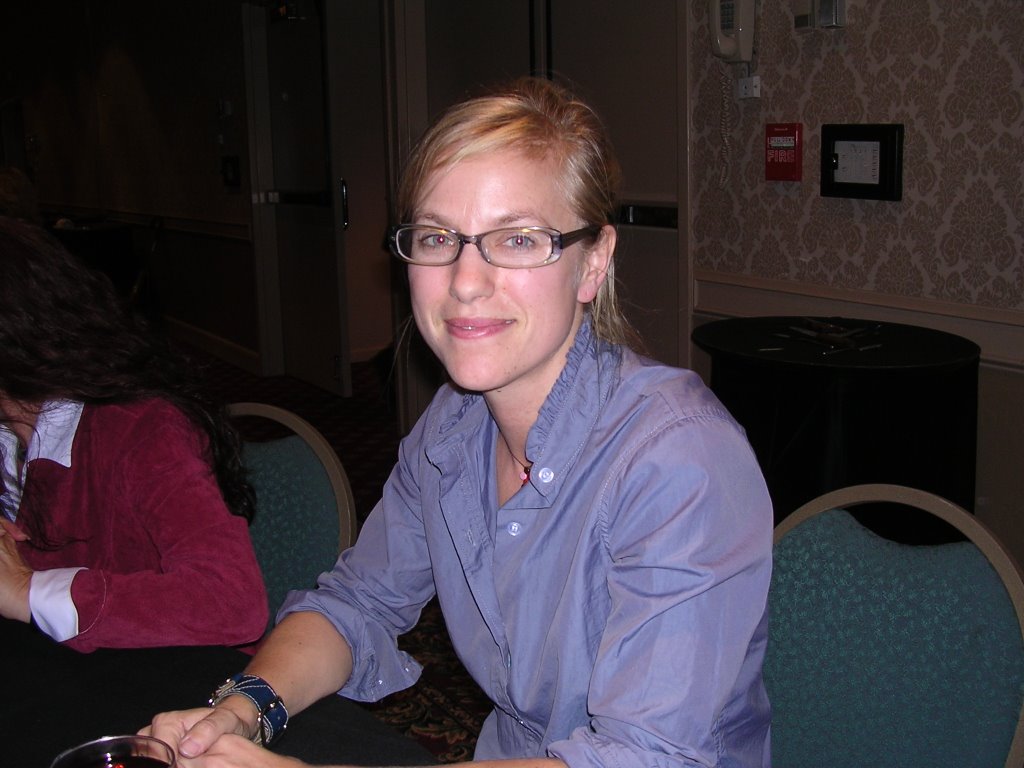

On Saturday night I once again attended “A Moveable Feast,” a banquet put on by the Northern California Independent Booksellers’ Association. It’s one of the highlights of the group’s annual convention and every year a few non-booksellers get to partake.

The evening features 12 authors whose books are just launching. The idea is for the authors to make personal contact with local bookstores, so the owners can hand sell books. And the idea seems to work – the authors are generally interesting and witty and people working in bookstores enjoy hearing them talk. Of course, there are lots of freebies. Every attendee gets an autographed copy of each of the author’s books.

I was sitting at a table with people from A Great Good Place For Books, my favorite bookstore in Oakland. Last year I had been invited to this event by Debi Echlin, the store owner. I had a great time, particularly because Debi was so jazzed by the entire evening. Unfortunately, Debi died in her sleep last November. But the store’s new owner, Kathleen Caldwell, invited me to join her and the women who work in her store.

Our table got to visit with three writers and all were charming. Heidi Julavits is one of those New York literary stars who captured public attention early in her writing career. She must be in her mid-30s, and with her long blonde hair and delicate face, she is photo-ready. Julavits is a co-founder of The Believer, the literary magazine started by Dave Eggers. She is married to Ben Marcus, whom she described as an “experimental” writer. They have a young daughter, Delia.

The Uses of Enchantment is Julavits’ third book and it centers on a girl named Mary, who may have been abducted or may have made up her abduction to garner attention. Julavits said she modeled her book on Tim O’Brien’s Lake of the Woods, another book that features a mysterious disappearance. Julavits is considered a literary writer, but she said all her novels are plot driven. “I loved Lake of the Woods by Tim O’Brien,” she said. “It has this inexorable plot pull. I love, love, love plot.”

Julavits was a “math kid,” growing up. “I loved logic proofs. That’s what plot is for me – a logic proof.”

She doesn’t write out her plots before she begins her novels. In fact, Julavits said she generally spends a year on a book, and then throws the entire thing away and starts over. She seems to need writing that trash draft in order to reach a zone that drives her writing to a higher level. “Because when you’re in that zone, writing a novel can be as pleasurable as reading a novel.”

Julavits is still an editor at The Believer and even finds time to teach fiction writing. She said she hammered her distaste for flashback scenes into her students this spring while she was copyediting The Uses of Enchantment. Then she would return home and see, to her dismay, how often she used flashbacks as a technique to explain characters. She ended up changing her book as a result.

Julavits said she loves doing it all – writing, teaching and editing. On editing: “It’s a phenomenal job to have. I feel its dovetails so well with fiction for me.”

On teaching: “If you teach a lot it can be draining. I taught last spring. It was so important for me to talk about what I think fiction is and can do and what is happening in fiction now and articulate all these issues.”

Thursday, October 05, 2006

Readers, Get on Your Walking Shoes

It’s that time of year again: Litquake, the nine-day extravaganza of words, authors, and literary musings. I went to the Lit Crawl for the first time last year and was impressed with the sheer number of people who wanted to spend their Saturday nights listening to various authors. It made me glad to live in the Bay Area.

I can’t make this year’s Crawl, which is a big disappointment, particularly because my friend Katherine Ellison will be reading from her book The Mommy Brain. She’s part of a panel called Mommy Lit: The Pleasures, Perils, and Politics of Motherhood featuring Joan Blades, Katherine Ellison, Kate Hodson, Ericka Lutz, Polly Pagenhart, and Rachel Sarah. The emcee: Peter Hartlaub. It’s at 6 p.m. at Ti Couz at 3108 16th Street

Here’s a write-up about the week by one of my students at the journalism school at UC Berkeley.

Authors are a "Cross to Bear"

I’m late to these blog posts but an anonymous editor is now writing regularly for Gawker about the publishing industry. The posts are titled “Unsolicited,” and the latest claims that “authors are a cross to bear somewhere between 'creepy messenger guy' and 'can't even afford a new coat from H&M" on the job-dissatisfaction scale. Because, with a few glowing exceptions, authors are the craziest, meanest, strangest, cluelessest people you've ever met.”

Gee. I thought they liked us.