I heard a terribly disturbing report on NPR on Tuesday. Apparently, so many pregnant women in India abort their female fetuses that the ratio of boys to girls is skewed. The killing of girl babies continues at a high rate despite the fact that abortion for sex-selection is illegal. It’s not just the poor who are aborting their daughters; the rich do it too. In the Punjab region, the wealthiest part of India, there are 100 boys to every 80 girls.
The Lancet, the British medical journal, estimates that 10 million female fetuses have been aborted in the last 20 years. In the Punjab region, the richest part of India, there are 100 boys to every 80 girls.
Girls are valued less in India because they cost their families money. Even though dowries are illegal, many grooms demand some sort of payment before they will take a woman as their wife. Girls are regarded as lesser, and sometimes not worth anything at all.
Tuesday, March 21, 2006


Monday, March 20, 2006
An Odd Assortment
The lively Tournament of Books begins tomorrow. It’s a contest with a bias – one that the organizers pronounce at the outset:
But, as we said, if we’re going to engage in the dubious exercise of turning art into competition, why not operate in an environment of total transparency? Let’s just admit the finalists were chosen in a mostly haphazard manner, that we likely overlooked as many deserving titles as we included. Let’s release the names of the judges and reveal their biases, and make the reasons for every decision available for all to read. Most importantly, let’s seed the books into a wagering-friendly, NCAA basketball-like tournament bracket and force 16 of the best-reviewed novels of the year into a winner-take-all battle royale of literary excellence, a phrase that one of these days we will get around to trademarking.
The first match-up is between Nicole Krauss’ History of Love and Dave Bergen’s The Time In Between.
EARTHQUAKE BLOG
I wrote about the great 1906 earthquake anniversary exhibit at Wells Fargo Bank. Well, the bank is doing something decidedly un- corporate – it has set up a blog about the Bay Area and earthquakes. There are lots of contributors, so the posts range from the historical to the philosophical. It’s fun.
FADE TO BLACK
On another business note, the Mercury News has set up a website, savethemerc.com, to try and enlist community support for the paper. It was put together by member of the Newspaper Guild and the idea is to show potential buyers there is demand for a high quality newspaper in the region. (I think this is a hint to cost-cutter Dean Singleton, who is a potential buyer.)
But, as we said, if we’re going to engage in the dubious exercise of turning art into competition, why not operate in an environment of total transparency? Let’s just admit the finalists were chosen in a mostly haphazard manner, that we likely overlooked as many deserving titles as we included. Let’s release the names of the judges and reveal their biases, and make the reasons for every decision available for all to read. Most importantly, let’s seed the books into a wagering-friendly, NCAA basketball-like tournament bracket and force 16 of the best-reviewed novels of the year into a winner-take-all battle royale of literary excellence, a phrase that one of these days we will get around to trademarking.
The first match-up is between Nicole Krauss’ History of Love and Dave Bergen’s The Time In Between.
EARTHQUAKE BLOG
I wrote about the great 1906 earthquake anniversary exhibit at Wells Fargo Bank. Well, the bank is doing something decidedly un- corporate – it has set up a blog about the Bay Area and earthquakes. There are lots of contributors, so the posts range from the historical to the philosophical. It’s fun.
FADE TO BLACK
On another business note, the Mercury News has set up a website, savethemerc.com, to try and enlist community support for the paper. It was put together by member of the Newspaper Guild and the idea is to show potential buyers there is demand for a high quality newspaper in the region. (I think this is a hint to cost-cutter Dean Singleton, who is a potential buyer.)

Sex Wars
When in was in my 20s, my all-time favorite author was Marge Piercy. I loved her readable yet highly political books that took a hard look at the excesses of American society.
Small Changes, about the changing America of the late 1960s and early 70s, vividy captures the time when drugs, sex, war, revolution and the emergence of a feminist movement were turning the country upside down. Vida, about a leftist revolutionary gone underground, was bold and romantic and seemed to express all my conflicted feelings about American imperialism.
Piercy took a dramatic left turn with Gone to Soldiers, a multi-layered narrative about World War II. In it, she used multiple characters to tell the stories of the conflicts in Europe and the Pacific, the Jews in concentration camps, and the war at home. It was a spell-binding book that also taught me a lot about World War II. Each character personified an aspect of the conflict.
But then something happened. Either my reading tastes changed or Piercy, who turns out a novel every few years, lost her touch. I really disliked He, She, and It, and was left lukewarm at Summer People and Three Women. I found the stories trite and unbelievable, written to convey an opinion rather than to tell a story. I concluded that I was done with Piercy. She was a chapter in my past, an author who had slowly faded away.
But on impulse – or out of habit – I bought Sex Wars, Piecry’s latest novel. It focuses on the early women’s movement through the use of multiple characters, the device that served her so well in Gone to Soliders. Piercy writes about Elizabeth Cady Stanton and Susan B. Anthony, two of the country’s earliest feminists; Victoria Woodhull, the first woman to run for president; Henry Ward Beecher, the famous preacher and brother of Harriet Beecher Stowe, whose Uncle Tom’s Cabin was one of the most popular books of the 19th Century, and many more.
To my surprise, I liked this book. Piercy’s writing can be wooden in sections but her characters are well fleshed out and the novel moves at a fast pace. Most importantly, I learned a great deal about the 19th century, including the shocking fact that once a woman married she lost all her rights. She was under the care of her husband and could not even testify in court since she was not considered an adult. She couldn’t vote and her property rights were restricted. Women who tried to branch out from their repressive roles were branded as sexually promiscuous and dangerous.
Sex Wars isn’t lyrical or literary but it is a great read. Welcome, back Marge.
Small Changes, about the changing America of the late 1960s and early 70s, vividy captures the time when drugs, sex, war, revolution and the emergence of a feminist movement were turning the country upside down. Vida, about a leftist revolutionary gone underground, was bold and romantic and seemed to express all my conflicted feelings about American imperialism.
Piercy took a dramatic left turn with Gone to Soldiers, a multi-layered narrative about World War II. In it, she used multiple characters to tell the stories of the conflicts in Europe and the Pacific, the Jews in concentration camps, and the war at home. It was a spell-binding book that also taught me a lot about World War II. Each character personified an aspect of the conflict.
But then something happened. Either my reading tastes changed or Piercy, who turns out a novel every few years, lost her touch. I really disliked He, She, and It, and was left lukewarm at Summer People and Three Women. I found the stories trite and unbelievable, written to convey an opinion rather than to tell a story. I concluded that I was done with Piercy. She was a chapter in my past, an author who had slowly faded away.
But on impulse – or out of habit – I bought Sex Wars, Piecry’s latest novel. It focuses on the early women’s movement through the use of multiple characters, the device that served her so well in Gone to Soliders. Piercy writes about Elizabeth Cady Stanton and Susan B. Anthony, two of the country’s earliest feminists; Victoria Woodhull, the first woman to run for president; Henry Ward Beecher, the famous preacher and brother of Harriet Beecher Stowe, whose Uncle Tom’s Cabin was one of the most popular books of the 19th Century, and many more.
To my surprise, I liked this book. Piercy’s writing can be wooden in sections but her characters are well fleshed out and the novel moves at a fast pace. Most importantly, I learned a great deal about the 19th century, including the shocking fact that once a woman married she lost all her rights. She was under the care of her husband and could not even testify in court since she was not considered an adult. She couldn’t vote and her property rights were restricted. Women who tried to branch out from their repressive roles were branded as sexually promiscuous and dangerous.
Sex Wars isn’t lyrical or literary but it is a great read. Welcome, back Marge.
Saturday, March 18, 2006
It’s great to have friends in all the right places. Pamela Mazzola and Nancy Oakes, wonderful chefs who wrote the cookbook, Boulevard, based on the San Francisco restaurant with the same name, have been nominated for a James Beard award.
This cookbook is a work of art with gorgeous full page color pictures of mouth-watering entrees, starters, and desserts. Before Pamela did this book, I had no idea how much work went into a cookbook. The authors have to try out all the recipes multiple times to get them right for a home kitchen. They have to create the food for the photos.
Even though Boulevard is arguable one of San Francisco’s most popular restaurants, the San Francisco Chronicle virtually ignored the book’s release. The paper has an excellent food section, one I love to read every week, but it only put in a short review of Boulevard, many weeks after its release. It took judges in New York to recognize the cookbook’s value.
I’m always baffled when newspapers ignore the talent in their own communities. There are so many good writers in the Bay Area and many times their books are never reviewed in the paper. I know there are space limitations, but you would think the Web-savvy Chronicle would at least have its own literary blog.
This cookbook is a work of art with gorgeous full page color pictures of mouth-watering entrees, starters, and desserts. Before Pamela did this book, I had no idea how much work went into a cookbook. The authors have to try out all the recipes multiple times to get them right for a home kitchen. They have to create the food for the photos.
Even though Boulevard is arguable one of San Francisco’s most popular restaurants, the San Francisco Chronicle virtually ignored the book’s release. The paper has an excellent food section, one I love to read every week, but it only put in a short review of Boulevard, many weeks after its release. It took judges in New York to recognize the cookbook’s value.
I’m always baffled when newspapers ignore the talent in their own communities. There are so many good writers in the Bay Area and many times their books are never reviewed in the paper. I know there are space limitations, but you would think the Web-savvy Chronicle would at least have its own literary blog.
Wednesday, March 15, 2006
19th Century San Francisco

I am going to be leading a book group at the Mechanic’s Institute in San Francisco Thursday night and the topic will be ethnic tensions in San Francisco.
These are not tensions between whites and black, or whites and Chinese, or Koreans and blacks. These are tensions between Bavarian-born Jews and those who came from Poland.
In the 1840s and 50s, a wave of Jews left their homelands in central Europe to come to the United States. While most settled on the East Coast, about 5,000 made their way to California. They went up to the gold mines but soon discovered they could earn better livings by selling to the miners. They became peddlers and shopkeepers.
The best known of these Jewish immigrants is Levi Strauss, whose decision to make jeans out of canvas launched a multi-billion dollar business that continues today. Other Jews who left their mark include the Haases (who married into the Levi Strauss family and who once owned the Oakland A’s), the Fleishhackers, (of the foundation and zoo) the Zellerbachs (who made a paper company) the Brandensteins (of MJB Coffee) and many more.
But there were class distinctions among these early Jewish pioneers. Those from Bavaria and Alsace-Lorraine considered themselves superior to those who came from Posen in Poland and Prussia. The Bavarians were mostly members of Temple Emanu-el and those from elsewhere were members of Sherith Israel.
Our book group will be talking about The Haas Sisters of Franklin Street: A Look Back with Love by Frances Bransten Rothmann and 920 O’Farrell Street: A Jewish Girlhood in Old San Francisco by Harriet Lane Levy, first published in 1937.
Rothmann’s book is a nostalgic reflection on her family, who lived in grand style on a now-iconic Victorian mansion on Franklin Street. (That's the house in the photo) Alice and Florine Haas were the daughters of William Haas, who owned a wholesale grocery store, and Bertha Greenbuam. Alice and Florine were second-generation Jews who got to enjoy – and use -- the money their parents earned. There were numerous parties and lunches and balls where the Bavarian Jews gathered together. These families also became influential in San Francisco and California, for the there was much less anti-Semitism in the west than the east.
Levy, whose memoir has been reissued by Heydey Books, came from the more Eastern European group of Jews. While she was an iconoclast who never married and traveled extensively with her childhood neighbor, Alice B. Toklas, Gertrude Stein’s lover, she never got over the snubbing she experienced in childhood. Here is one of my favorite passages about the tension between Bavarian Jews and Polish Jews:
“That the Baiern (Bavarians) were superior to us, we knew,” wrote Levy. “We took our position as the denominator takes its stand under the horizontal line. On the social counter the price tag “Polack” confessed second class. Why Poles lacked the virtues of Bavarians I did not understand, though I observed that to others the inferiority was as obvious as it was to us that our ashman and butcher were of poorer grade than we, because they were ashman and butcher … Upon this basis of discrimination everybody agreed and acted.”
It is amazing today to think of the strength of this ethnic tension, coming among people who had more in common with one another than with the rest of the world. And it is interesting to note that the tension was a defining characteristic of San Francisco in the 1860s and 1870s. In the 1880s, the Jewish world shifted again with the influx of thousands of Jews from an even more easterly-part of Europe: Russia. If the Germans thought the Posen-born Jews were indecorous, they soon saw they had many more commonalities than they imagined.
Of course, there were other ethnic tensions that colored San Francisco. The Irish were the most dominant group, but the Chinese, and later the Japanese, were the most vilified. While California was a tolerant state in many ways, built on an instant gold society that gave access to almost everyone, it still contained too much racial insensitivity.
Monday, March 13, 2006
Bad News for Bay Area Journalism
At first I was happy when I heard McClatchy Newspapers was going to buy Knight-Ridder. McClatchy, an esteemed chain that started when James McClatchy started the Sacramento Bee in 1857, is respected for its high quality journalism.
But, as they say, the devil is in the details. McClatchy will pay $4.5 billion for the chain, but will sell 12 of the Knight-Ridder papers, including the San Jose Mercury News, the Contra Costa Times, and the two Philadelphia papers, because they are not in "growing markets".
That sucks. The Mercury is an excellent newspaper, one dedicated to its community and in-depth reporting. I worked there for nine years and saw how the paper lifted the quality of all the newspapers in the Bay Area. Competition works in the newspaper business; reporters hate to be scooped so they hustle to get there first. Mercury reporters always wanted to be in front of Chronicle reporters and the tension made for some good journalism. If the quality of the Mercury News drops, it will affect the rest of the region's papers as well.
I also don’t understand McClatchy’s reasoning. The Mercury and The Philadelphia Inquirer are two of the country’s most distinguished papers with many Pulitzer Prizes between them. But they are not good enough because their profit margins aren’t high enough?
The other newspaper chains that were prowling around Knight-Ridder do not have such good journalistic reputations and I am afraid the Merc will go to one of them. The most obvious buyer is Dean Singelton’s MediaNews, based in Denver. Singeleton started his career by buying a chain of East Bay papers that included the Fremont Argus and Hayward Daily Review, later adding the Oakland Tribune and the Marin Independent-Journal.
Singelton quickly put his imprint on the papers – i.e. he cut staff and emphasized shorter, less fully-reported pieces. He’s used the same m.o. for his papers in Dallas and Denver. Not one of those papers is as good as the Mercury News or even the Contra Costa Times. This bodes badly for Bay Area journalism.
All this started when the largest minority holder of Knight-Ridder stock forced a sale by complaining his stock price was too low. The sale continues the sad and dangerous trend of selling news to the highest bidder. News is regarded now as a commodity, not a public right.
But, as they say, the devil is in the details. McClatchy will pay $4.5 billion for the chain, but will sell 12 of the Knight-Ridder papers, including the San Jose Mercury News, the Contra Costa Times, and the two Philadelphia papers, because they are not in "growing markets".
That sucks. The Mercury is an excellent newspaper, one dedicated to its community and in-depth reporting. I worked there for nine years and saw how the paper lifted the quality of all the newspapers in the Bay Area. Competition works in the newspaper business; reporters hate to be scooped so they hustle to get there first. Mercury reporters always wanted to be in front of Chronicle reporters and the tension made for some good journalism. If the quality of the Mercury News drops, it will affect the rest of the region's papers as well.
I also don’t understand McClatchy’s reasoning. The Mercury and The Philadelphia Inquirer are two of the country’s most distinguished papers with many Pulitzer Prizes between them. But they are not good enough because their profit margins aren’t high enough?
The other newspaper chains that were prowling around Knight-Ridder do not have such good journalistic reputations and I am afraid the Merc will go to one of them. The most obvious buyer is Dean Singelton’s MediaNews, based in Denver. Singeleton started his career by buying a chain of East Bay papers that included the Fremont Argus and Hayward Daily Review, later adding the Oakland Tribune and the Marin Independent-Journal.
Singelton quickly put his imprint on the papers – i.e. he cut staff and emphasized shorter, less fully-reported pieces. He’s used the same m.o. for his papers in Dallas and Denver. Not one of those papers is as good as the Mercury News or even the Contra Costa Times. This bodes badly for Bay Area journalism.
All this started when the largest minority holder of Knight-Ridder stock forced a sale by complaining his stock price was too low. The sale continues the sad and dangerous trend of selling news to the highest bidder. News is regarded now as a commodity, not a public right.
Sunday, March 12, 2006
100th Anniversary of the 1906 San Francisco Earthquake

I’ve been walking around San Francisco in a state of excitement for weeks now. As I prowl the downtown area, strolling by Union Square or the Old Mint on Fifth Street near Mission, black and white images come into my mind. Instead of seeing what’s actually there, I envision what remained after the devastating earthquake of April 18, 1906. I imagine myself cast back to those terrible days when the city shook and burned.
The 100th anniversary of the San Francisco earthquake is approaching and it’s a magical time for history lovers. The whole city seems to be gearing up for a massive celebration. Every time I am at the California Historical Society, I see journalists and scholars preparing shows on the quake. It maked me determined to see as many of the exhibits on the quake as I possibly can.
The main Wells Fargo Bank office on California and Montgomery has a wonderful exhibit, including an earthquake simulator. You can stand on a platform and wiggle your body to create a sense of the force of the shake of the earthquake, which measured anywhere from 7.8 to 8.6 on the Richter scale.
The reason I love this exhibit is because it shows some of the history of my family, some of the history I am writing about in my book Towers of Gold. My great great grandfather Isaias Hellman was the president of Wells Fargo Bank at the time of the earthquake. The bank building burned completely, but the vault survived. Bank officials had to wait two weeks until the air in the vault cooled completely before opening it. If they opened it any soon, a fresh supply of oxygen might have ignited the contents and burned all the bank's records. The exhibit shows photos of the opening of the vault, as well as the temporary headquarters of the bank on Jackson Street.
The California Historical Society on Mission Street has a wonderful exhibit centered around the pictures Jack London and his wife Charmain took of the ruins after the earthquake and fire. The Londons were at their home in Sonoma when the quake hit, and were hired by Collier’s magazine to write an article on the devastation. They spent many sleepless nights wandering all over the city, interviewing survivors and recording the many scenes of devastation.
The Museum of Modern Art has a photo exhibit, as does the California Legion of Honor. In that show, famed photographer Mark Klett juxtaposes earthquake photos with modern-day shots of the same locales. He included one of 2020 Jackson Street, the temporary home of Wells Fargo Bank and the permanent home of Hellman’s daughter and son-in-law.
There will be all sorts of commemorations of the earthquake. Each year, the city of San Francisco sponsors an event at Lotta’s Fountain at 5:12 am the morning of the anniversary of the quake. A dwindling pool of quake survivors always come and are honored for living through the catastrophe. This year, officials are expecting thousands, rather than hundreds, to show up.
The San Francisco Chronicle plans to reprint the paper that was published April 19, the day after the quake, with its famous headline “San Francisco in Ruins.” All the buildings housing the newspapers burned – including the newly constructed skyscraper that housed the San Francisco Call – and so three papers joined forces that night and published on the press of the Oakland Herald.
There are some great on-line narratives and histories of the earthquake, including eyewitness accounts that will make you shiver. The Virtual Museum of San Francisco is a wonderful resource, with hundreds of captivating reports. The San Francisco Public Library has put its earthquake pictures on-line, and will present displays on the quake in Main Library in the Civic Center as well as at branch libraries around the city. The Bancroft Library has assembled the world’s largest collection of information on the quake. It has also put together an exhibit in doe Library.
Saturday, March 11, 2006
Liz Perle

I had a chance this week to hear Liz Perle read from her new book, Money, A Memoir: Women, Emotions, and Cash. Besides having one of the most attractive book covers I have ever seen (a beautiful pare green background with a small green striped coin purse on the front) this book reveals some hard truths.
Despite rushing into the workforce in record numbers, many women today are economic neophytes, reluctant to bargain for higher salaries, learn the ins and outs of their family’s finances, or put away funds for the future, when they most likely face time alone.
Many women still have the fantasy that Prince Charming, in the disguise of a rich husband, will rescue them from having to forge their own financial futures. They live from paycheck to paycheck and put everything else on their credit cards. And as society becomes more label conscious, with young girls being targeted to know – and care about – Coach bags, Lucky jeans, etc -- women’s debt loads are increasing at an alarming rate.
Perle came to see her economic dysfunction the hard way: She had moved to Singapore to join her husband at his new job, only to discover he had found a new girlfriend. She found herself on a plane to San Francisco with her four year old son, no home, and $1,500 in her pocket.
“This isn’t a rags to riches story,” Perle told the crowd at A Great Good Place for Books in Montclair in Oakland. “How on earth did someone who ran a company and went to a good college end up on a friend’s couch with only $1500 and all my assets a half a world away under the control of my soon-to-be ex-husband? How had I been a party to the situation?
Perle’s book is on the San Francisco Chronicle’s best-seller list. (She lives in the city and is the director of Common Sense Media) Ed Champion has a podcast interview with her here.
Tuesday, March 07, 2006
Barry Bonds ... a Steroid User?
"Barry Bonds began using steroids after the 1998 baseball season and came to rely on a wide variety of performance-enhancing drugs over the next several years, according to a book written by two Chronicle reporters and excerpted in this week's Sports Illustrated," the Associated Press reported Tuesday.
Reporters Lance Williams and Mark Fainaru-Wada are the authors of Game of Shadows: Barry Bonds, BALCO, and the Steroids Scandal that Rocked Professional Sports. It will be published by Gotham Books on March 27.
Reporters Lance Williams and Mark Fainaru-Wada are the authors of Game of Shadows: Barry Bonds, BALCO, and the Steroids Scandal that Rocked Professional Sports. It will be published by Gotham Books on March 27.
Community of Writers at Squaw Valley
I just got my brochure for the summer writing workshop up at Squaw Valley. Just reading it made me excited. There are so many excellent writers, agents, and editors planning to attend.
On the fiction front, Elizabeth Rosner, Janet Fitch, Lynn Freed, Richard Ford, Bill Barich, James Houston, Mark Childress, Jerry Tervalon, Alice Sebold and Glen David Gold are planning to lead seminars.
The non-fiction writers include Anthony Swofford, Martin J. Smith and Rick Wartzman.
Michael Pietsch, from Little, Brown and Company will be there, as will Ann Close from Knopf, and Ann Patty of Harcourt Books. The agents include Michael Carlise of Inkwell Management, Henry Dunow of Dunow, Carlson & Lerner Literary Agency, and Randi Murray.
The Community of Writers at Squaw Valley was started more than 30 years ago by the novelist Oakley Hall. Now his daughter Brett Hall Jones (who is married to novelist Louis B. Jones) runs the various workshops. Another daughters, the novelist and playwright Sands Hall, teaches fiction. Other family members chip in to help. Most of the writers and editors and agents who come are long-time friends of the Halls, so the entire event feels like a family party. There’s no hierarchy – top publishers chat easily with unpublished writers – and then spoof themselves at a final talent show.
I applied on a lark about three years ago. It was an amazing week. The setting in the Sierra is spectacular and the critiques I got in the workshops were wonderful. The experience led to the whole shebang – agent, publisher, etc.
I highly encourage aspiring authors to apply. There is a lot of talk in the writing world about the benefit of MA programs and writing workshops. They are criticized for creating automatons, writers who sound alike. I can’t speak to the former but I can about the latter. Where else do you get to immerse yourself in a world of words and meet people who are as nerdy as you and revel in talking about voice, pacing, characterizations, selling your book?
I didn’t attend the workshop last year. But I dropped in for two days to hear the free afternoon lectures. I may have to repeat the trip.
On the fiction front, Elizabeth Rosner, Janet Fitch, Lynn Freed, Richard Ford, Bill Barich, James Houston, Mark Childress, Jerry Tervalon, Alice Sebold and Glen David Gold are planning to lead seminars.
The non-fiction writers include Anthony Swofford, Martin J. Smith and Rick Wartzman.
Michael Pietsch, from Little, Brown and Company will be there, as will Ann Close from Knopf, and Ann Patty of Harcourt Books. The agents include Michael Carlise of Inkwell Management, Henry Dunow of Dunow, Carlson & Lerner Literary Agency, and Randi Murray.
The Community of Writers at Squaw Valley was started more than 30 years ago by the novelist Oakley Hall. Now his daughter Brett Hall Jones (who is married to novelist Louis B. Jones) runs the various workshops. Another daughters, the novelist and playwright Sands Hall, teaches fiction. Other family members chip in to help. Most of the writers and editors and agents who come are long-time friends of the Halls, so the entire event feels like a family party. There’s no hierarchy – top publishers chat easily with unpublished writers – and then spoof themselves at a final talent show.
I applied on a lark about three years ago. It was an amazing week. The setting in the Sierra is spectacular and the critiques I got in the workshops were wonderful. The experience led to the whole shebang – agent, publisher, etc.
I highly encourage aspiring authors to apply. There is a lot of talk in the writing world about the benefit of MA programs and writing workshops. They are criticized for creating automatons, writers who sound alike. I can’t speak to the former but I can about the latter. Where else do you get to immerse yourself in a world of words and meet people who are as nerdy as you and revel in talking about voice, pacing, characterizations, selling your book?
I didn’t attend the workshop last year. But I dropped in for two days to hear the free afternoon lectures. I may have to repeat the trip.
Monday, March 06, 2006
A Winter Writing Retreat
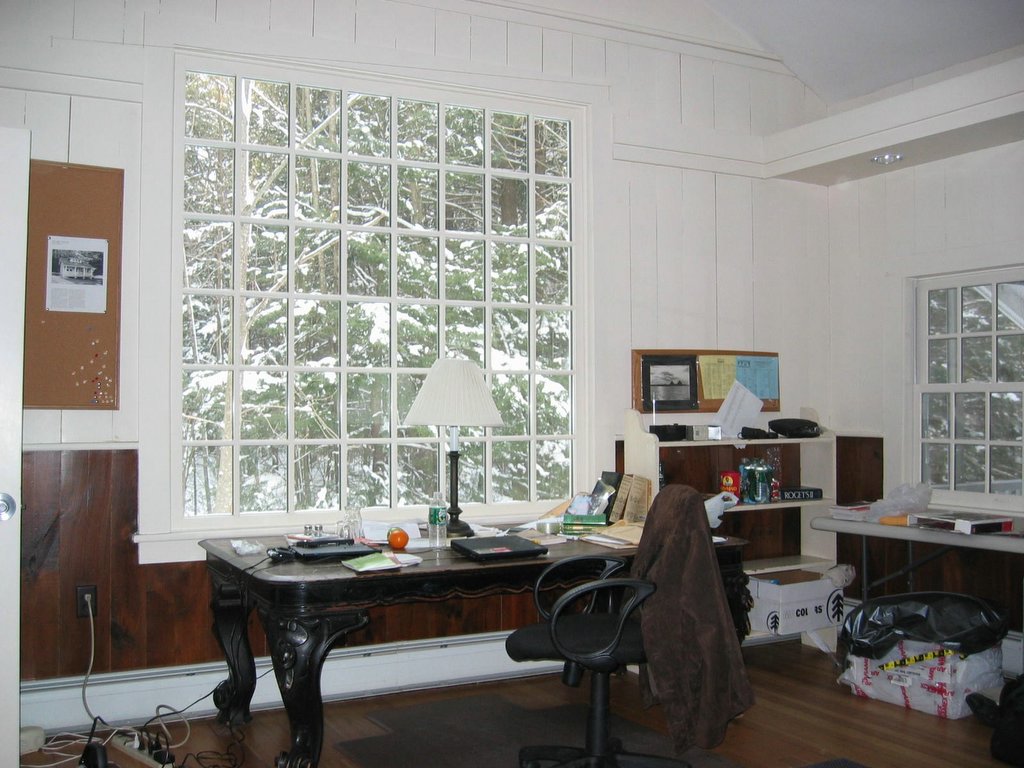
 Since January, I have spent about two weeks cloistered in my parents' house in Geyserville, writing away. It was a wonderful respite -- I loved being able to write and read from morning to night without thinking of anyone by myself. Both trips were very productive and although I was eager to get back and see my family, I was sorry to interrupt the intensely productive period.
My friend Neil has been at the MacDowell Colony in New Hampshire for the past few weeks. I was curious what it looked like, so he sent me these photos.
I think I could get a lot of writing done here, too. The cottage looks cozy in winter. The staff brings you your lunch as well. No care, no worries.

A Worthy Book Contest
The second annual Tournament of Books sponsored by Powell's Books is gearing up. The contest organizers have announced this year’s judges, which include those with deep literary connections such as Brigid Hughes, the editor of Public Space and former editor of Paris Review – and those without – such as Nell James, a 17 year old progressive rock musician. Lit bloggers Maud Newton, Mark Sarvas, and Jessa Crispin will also serve as judges.
Sixteen books will compete against one another for the grand prize. Each book will be paired against another and the winner will continue to the next bracket until it’s winnowed down to a final two.. and then a winner. For example, Jonathan Safer Froer’s book Extremely Loud and Incredibly Close will compete against The History of Love, written by his wife Nicole Krauss. (The critics sort of compared them anyway in articles; now they will actually go head to head).
What I love about this contest is you get to see what “ordinary” people think about the books they read. You get to cheer for the books you’ve read and hiss at those you know nothing about. Sort of like the Oscars.
Sixteen books will compete against one another for the grand prize. Each book will be paired against another and the winner will continue to the next bracket until it’s winnowed down to a final two.. and then a winner. For example, Jonathan Safer Froer’s book Extremely Loud and Incredibly Close will compete against The History of Love, written by his wife Nicole Krauss. (The critics sort of compared them anyway in articles; now they will actually go head to head).
What I love about this contest is you get to see what “ordinary” people think about the books they read. You get to cheer for the books you’ve read and hiss at those you know nothing about. Sort of like the Oscars.
Saturday, March 04, 2006
A Grotto Night to Remember
After spending 3 days in Big Sur looking out at a beautiful Pacific Ocean (and dodging hail, rain, thunder and lightening) I reentered civilization Friday night with a splash.
The Grotto, the San Francisco writer's cooperative, threw itself a big party to celebrate its move to new headquarters on Second Street, right near the Bay Bridge and South Park. The new office can only be described as swank. There's a central space painted with bold primary colors surrounded by individual offices. It's a far cry from the early 1990s, when Po Bronson and Ethan Canin came up with the idea of a common office for writers.
Lots of writers, filmmakers, agents and editors came to drink tea from the Samovar Tea House, swill red wine donated by Ravenswood and talk shop. Undoubtedly there were many people I didn't recognize, but I did spot Bronson, Laura Fraser, Tom Barbash, Dan Geller and Dayna Goldfine, who did the acclaimed documentary Ballets Russes, Connie Hale, Rachel Howard, Christopher D. Cook, Todd Oppenheimer, Katy Butler, and many more.
There was a small but loyal turnout from my writing group, North24th. Allison Hoover Bartlett from the group just joined the Grotto. Katherine Neilan, Jill Storey, and I came to cheer her on.
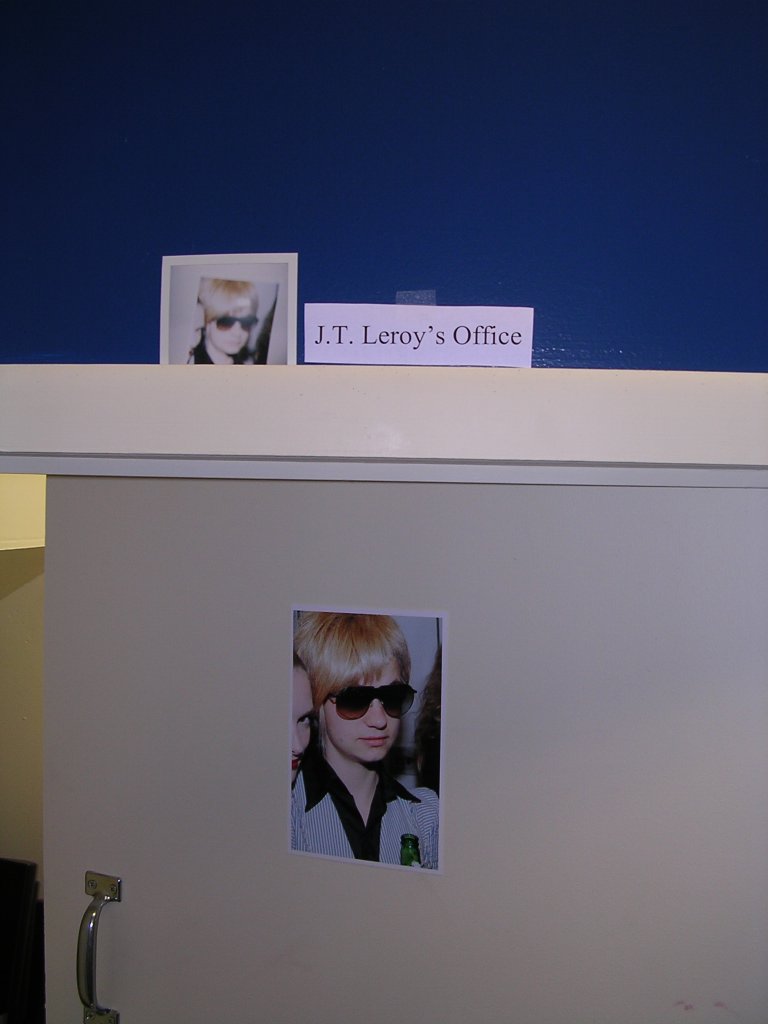
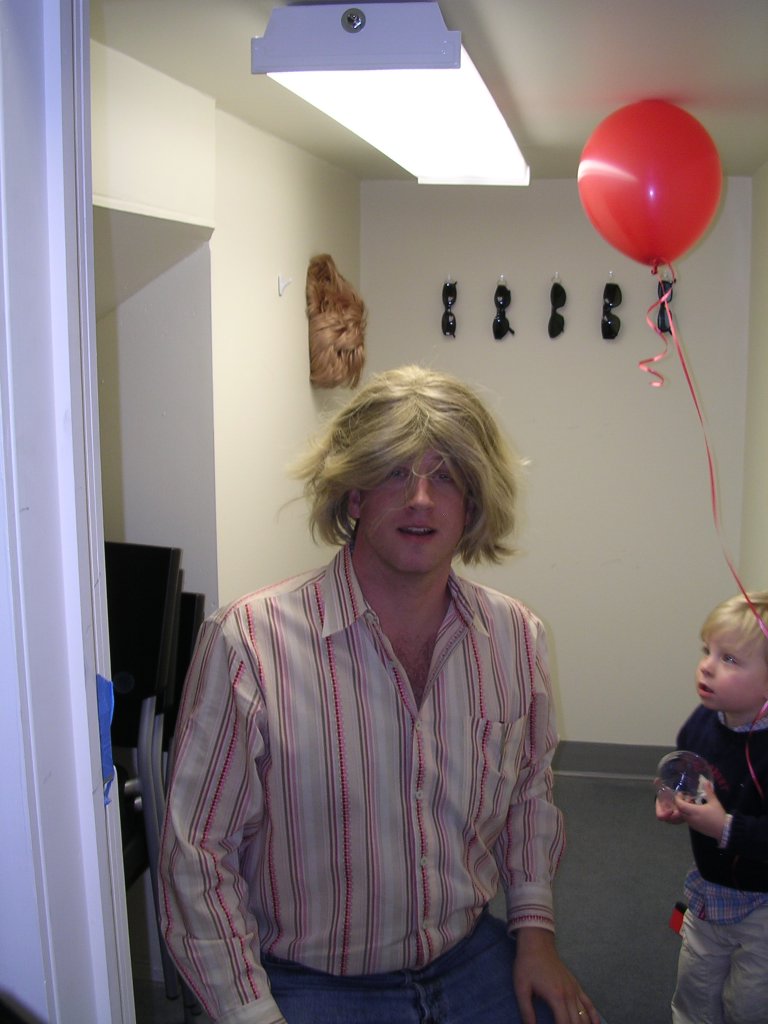
Apparently, J.T. LeRoy stopped in for a moment, but then disappeared into the men's (women's? ) bathroom.
The Grotto, the San Francisco writer's cooperative, threw itself a big party to celebrate its move to new headquarters on Second Street, right near the Bay Bridge and South Park. The new office can only be described as swank. There's a central space painted with bold primary colors surrounded by individual offices. It's a far cry from the early 1990s, when Po Bronson and Ethan Canin came up with the idea of a common office for writers.
Lots of writers, filmmakers, agents and editors came to drink tea from the Samovar Tea House, swill red wine donated by Ravenswood and talk shop. Undoubtedly there were many people I didn't recognize, but I did spot Bronson, Laura Fraser, Tom Barbash, Dan Geller and Dayna Goldfine, who did the acclaimed documentary Ballets Russes, Connie Hale, Rachel Howard, Christopher D. Cook, Todd Oppenheimer, Katy Butler, and many more.
There was a small but loyal turnout from my writing group, North24th. Allison Hoover Bartlett from the group just joined the Grotto. Katherine Neilan, Jill Storey, and I came to cheer her on.
Apparently, J.T. LeRoy stopped in for a moment, but then disappeared into the men's (women's? ) bathroom.
 Grottoing from Left to Right: Kathryn Ma, whose short stories have appeared in The ThreePenny Review and Kalliope; Danielle Svetcov, a writer and an agent for the Levine Greenberg Literary Agency; Jill Storey, whose work has appeared in Salon and on KQED's Perspectives; and Allison Hoover Bartlett, a Grottoite whose most recent piece on a book thief appeared in San Francisco Magazine.

Wednesday, March 01, 2006
Long Silence ....
I have been traveling so much – to Sonoma, Tahoe, and now to Big Sur – that I haven’t had time to post anything on Ghost Word. It’s interesting to see how I can be so consumed by blogging, and then so alternately disinterested. It’s almost an all-or-nothing proposition.
I’ll be back next week and have no more travel plans and will resume my forays into the world of books and writing.
I’ll be back next week and have no more travel plans and will resume my forays into the world of books and writing.
Subscribe to:
Posts (Atom)