Anne Lamott reminds us we can’t just sit idly by and watch as the Bush people continue to take over. She’s calling for a revolution of sorts on Salon, and has a date in mind: July 14.
“I, for one, do not want to answer that I did nothing, or that I ranted and flailed, showing up to support my own interest groups, candidates and concerns.
Instead, I think we should lay down our differences, and have a revolution. I am wondering if July 14 works for everyone.
My father wrote a great novel about an antiwar march in 1970, called "The Bastille Day Parade," in which many protesters carried signs that read, "Turn Off the Lie Machine." In choosing July 14, I would like to pay tribute to him and to the people of his generation, who are surely turning in their graves, as if on rotisseries, with horror about life in their beloved America. They were passionate in their fight against fascism, and Joseph McCarthy, their commitment to civil rights, and to libraries, and to good manners. All of us were raised to be polite, as honest as we could manage, and to live as if the word "fair" meant something, which all sounds a little Amish at this point. A renewal of these values would be the major plank of this revolution.
In this revolution, there will not be any positions except kindness, and libraries. We will not even have a battle cry, as that can lead to chanting, and haranguing: Hey, hey, ho, ho, all that chanting's got to go! We would simply look one another in the eyes, shake our heads, and say, "This just can't be right." We will not try to figure out what it all means: Iraq, Guantánamo, Abu Ghraib, Terri Schiavo, abortion rights, the Downing Street Memo, domestic spying, immigration, the Kyoto Accords, the Geneva Connections, Tom DeLay -- none of it. We all know what kindness means, and I think we can all agree that libraries are sacred, and our revolution will decree that we will fight tooth and nail for these things, politely. “
And later …
“We would all show up on Bastille Day, propelled by the ferocious, heartbroken belief we've carried since childhood, that America is a republic, of 50 states, united and humane.
It would be nice if everyone would turn off his or her cellphone that day. “
I don't think George Bush would notice, but since he can't even admit the ice caps are melting, he's besides the point. (My husband calls him "The Bubble Boy) I'd go.
Wednesday, March 29, 2006


Beautiful Words or Heartbreaking Story: You Choose
Zadie Smith’s On Beauty got knocked out by Uzodinma Iweala’s Beasts of No Nation in today’s Tournament of Books.
It’s the tournament's first big upset, according to commentator Kevin Guilfoyle: “Say hey! Just when you thought the first round was going to pass without a major upset, Karl Iagnemma, a popular writer of robot erotica (I might be confused on that point), throws the bookies into a Black Friday panic by sending pre-tournament Final Four lock Zadie Smith packing on the QE II. It’s the first hair-dryer-in-the-tub shocker of the tournament, with one of the year’s most celebrated books falling to a graduate creative writing thesis project.”
The judge, Karl Iagnemma, summed up perfectly my feelings about On Beauty. He lauds Smith’s ability to create so many smart, convincing, funny and verbose characters, but then grows weary of their patter.
“This book’s blessing also seems to be its curse: The fluency of the voice and the interestingness of the characters leads to long, long exchanges, long descriptions, and long scenes. There are just so many…words. The effect is that it all begins to seem scattershot, even random, a shotgun blast of talented prose. I felt like I was on a cross-country road trip with an extremely smart but crushingly talkative acquaintance. I was ready to bail somewhere around Ohio—page 160, by my count—and I would have stopped reading were I not a “judge” for this tournament. I found myself wishing, truly wishing, for a bit of writerly remove. But British writers have never seemed all that fond of writerly remove.”
Despite that, I have to say I am glad I read Smith’s book. Her ability to spin words is remarkable, and offers much more than many other books.
It’s the tournament's first big upset, according to commentator Kevin Guilfoyle: “Say hey! Just when you thought the first round was going to pass without a major upset, Karl Iagnemma, a popular writer of robot erotica (I might be confused on that point), throws the bookies into a Black Friday panic by sending pre-tournament Final Four lock Zadie Smith packing on the QE II. It’s the first hair-dryer-in-the-tub shocker of the tournament, with one of the year’s most celebrated books falling to a graduate creative writing thesis project.”
The judge, Karl Iagnemma, summed up perfectly my feelings about On Beauty. He lauds Smith’s ability to create so many smart, convincing, funny and verbose characters, but then grows weary of their patter.
“This book’s blessing also seems to be its curse: The fluency of the voice and the interestingness of the characters leads to long, long exchanges, long descriptions, and long scenes. There are just so many…words. The effect is that it all begins to seem scattershot, even random, a shotgun blast of talented prose. I felt like I was on a cross-country road trip with an extremely smart but crushingly talkative acquaintance. I was ready to bail somewhere around Ohio—page 160, by my count—and I would have stopped reading were I not a “judge” for this tournament. I found myself wishing, truly wishing, for a bit of writerly remove. But British writers have never seemed all that fond of writerly remove.”
Despite that, I have to say I am glad I read Smith’s book. Her ability to spin words is remarkable, and offers much more than many other books.
Tuesday, March 28, 2006
A Repackaged Book and A New One
I went into a Barnes and Noble on Tuesday and was assaulted by the huge stack of paperback editions of The Da Vinci Code. The publishers left no impulse denied when issuing versions of this book, which has been a bestseller for about two years.
There was a trade paperback edition, a mass market edition, an annotated edition, an illustrated edition, a recorded edition, and an Italian edition. That’s six different versions of this book. There was also an illustrated study guide. I can’t believe there is anyone who hasn’t read this book yet, but if there is, they have numerous variations to choose from.
By the end of the day, the trade paperback was #22 on Amazon. I guess there are people who are looking for more space on their shelves, and decided to buy a smaller version and ditch the hardback.
As for me, I read the book when it first came out and can barely remember it anymore. There was something about Jesus and Mary being married?
***
The buzz has started on Michael Pollan’s book, The Omnivore’s Dilemma: A Natural History of Four Meals. It won’t be released until April 11, but Time Magazine already has a positive review. Here’s an excerpt:
“Consider the Chicken McNugget. What's in it exactly? There's some chicken, of course. Salt, no doubt. And then there's all that mysterious stuff identified in the ingredients brochure. Sodium aluminum phosphate--what is that, and where does it come from? For that matter, where does the chicken come from?
Right there, Michael Pollan tells us, is the problem with the way we eat now. We're clueless. In The Omnivore's Dilemma (Penguin Press; 450 pages), he tries to cut through this fog of unknowing.”
Pollan is about to start making the rounds of bookstores and lecture halls. He is an engaging speaker – personal, self-deprecating, and knowledgeable. Even if you don’t plan to buy his newest book, it’s worth seeking him out. He’ll be interviewed by Davia Nelson of the Kitchen Sisters at the UC Berkeley Haas Business School on April 17 and will be talking with Roy Eisenhardt at City Arts and Lectures on April 26, among many other appearances.
Sunday, March 26, 2006
The Pain of a Senseless Death
Meredith Maran has written a moving article in Salon about Keith Stephens, whom she profiled in her book Class Dismissed and who was murdered in Berkeley five weeks ago.
The tribute celebrates Keith’s life, which was filled with loving relatives, minor scrapes with the law, a learning disability, and recent success in his work life. Keith was shot in the chest when he opened the door of a friend's house. His killer has not been identified.
Meredith, who followed Keith around while he was a senior at Berkeley High School, raises large questions about the value – or lack of it – society places on the lives of African-American youths.
“In the days following Keith's death I received 58 condolence e-mails, many from people I don't know: Keith's middle school teacher, the D.A. who prosecuted him, his manager at Starbucks, a Berkeley police lieutenant whose daughter goes to Berkeley High. They wrote about his kindness, his sense of humor, his way with little kids and his smile. They called what happened to him "senseless violence."
But the violence that took Keith's life wasn't senseless. It happened for reasons that any one of us could name -- start with slavery, take it from there. Spending one year in Keith's reality, I learned nothing more predictive than this: Give a kid the message that you'd rather he just disappeared from your store, your classroom, your streets, and sooner or later, one way or another, he will.
"You strip a people of their pride," Jesse told me the morning of Keith's funeral, as we drove to Mama's house to ride with the family to the church. "You strip the men of their masculinity. Then, if someone disrespects a man, to retain his pride he has to kill that person."
This is the second tragedy for Meredith this year. She also knew Meleia Willis-Starbuck, who was shot near her apartment in Berkeley in July while arguing with a group of Cal football players. Meleia’s good friend, Christopher Hollis has been charged in the shooting, although he was not aiming deliberately at her.
The tribute celebrates Keith’s life, which was filled with loving relatives, minor scrapes with the law, a learning disability, and recent success in his work life. Keith was shot in the chest when he opened the door of a friend's house. His killer has not been identified.
Meredith, who followed Keith around while he was a senior at Berkeley High School, raises large questions about the value – or lack of it – society places on the lives of African-American youths.
“In the days following Keith's death I received 58 condolence e-mails, many from people I don't know: Keith's middle school teacher, the D.A. who prosecuted him, his manager at Starbucks, a Berkeley police lieutenant whose daughter goes to Berkeley High. They wrote about his kindness, his sense of humor, his way with little kids and his smile. They called what happened to him "senseless violence."
But the violence that took Keith's life wasn't senseless. It happened for reasons that any one of us could name -- start with slavery, take it from there. Spending one year in Keith's reality, I learned nothing more predictive than this: Give a kid the message that you'd rather he just disappeared from your store, your classroom, your streets, and sooner or later, one way or another, he will.
"You strip a people of their pride," Jesse told me the morning of Keith's funeral, as we drove to Mama's house to ride with the family to the church. "You strip the men of their masculinity. Then, if someone disrespects a man, to retain his pride he has to kill that person."
This is the second tragedy for Meredith this year. She also knew Meleia Willis-Starbuck, who was shot near her apartment in Berkeley in July while arguing with a group of Cal football players. Meleia’s good friend, Christopher Hollis has been charged in the shooting, although he was not aiming deliberately at her.
Friday, March 24, 2006
How Do You Organize Your Books?
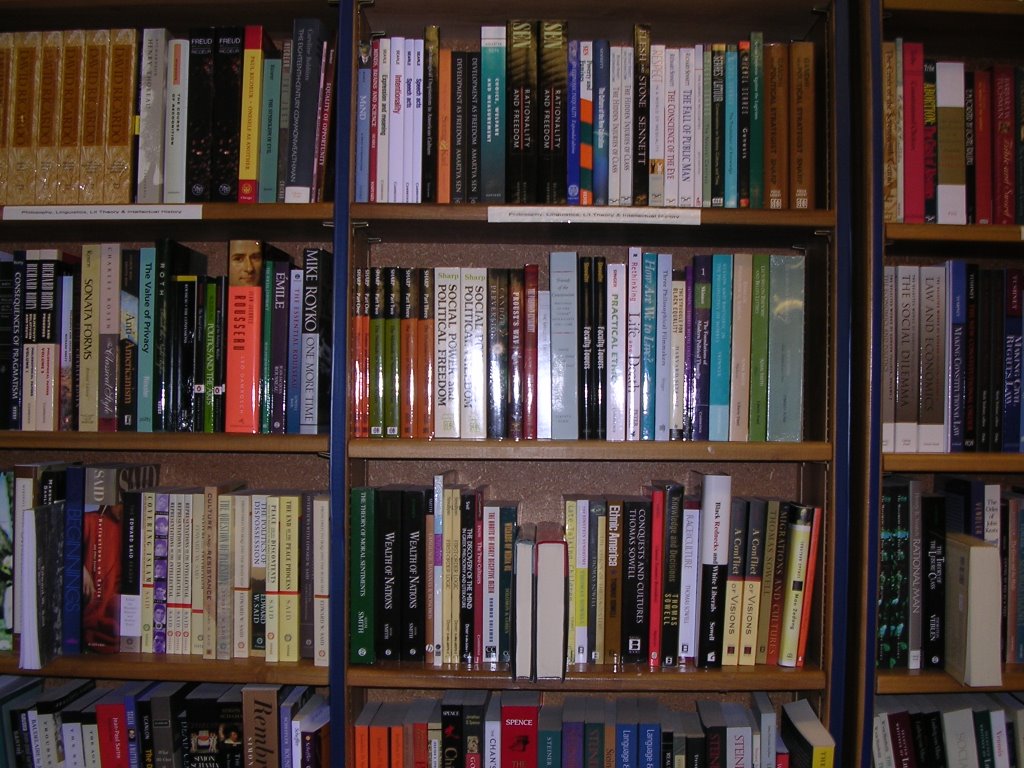
Do you arrange alphabetically or do you believe in the Random Theory of Book Storage? I confess my library is a total mess – books shoved here and there, piled up on the edge of shelves (where they often crash to the ground with a terrible bang). Chaos, chaos, everywhere,
At least I am alone in my madness. That’s not the case with the Washington Post’s book critic and the editor of the paper’s book section. Jonathan Yardley and Maria Arana are married to one another and they have wildly diverging ways of organizing their books.
“She insists hers is a simple (he says simple-minded) system. It is an approximate equivalent of that great old game 52 Pickup: Throw the cards in the air and, wherever they land, deal with it. She flings her books onto the shelves in her office with, as football coaches like to say, reckless abandon -- Russian next to Spanish, Amy Tan next to Dickens, Kafka next to Germaine Greer -- and somehow they land in a pattern that makes perfect sense to her but to anyone else is an unfathomable mystery.
He has this quaint idea: He'd like to be able to find his books when he wants them. So he has devised this simple (she says simple-minded) system: nonfiction upstairs, fiction downstairs, and, in his office -- which is on the opposite side of the house from hers -- biographies are arranged alphabetically by subject, and the rest is organized by category: history, lit crit, sports, travel. . . . Sensible, don't you think?”
The essay reminds me of the first chapter of Anne Fadiman’s wonderful book, Ex Libris: Confessions of a Common Reader. It’s titled, “Marrying Libraries,” and it explores what happens when two bookworms with large libraries and strong tastes merge their collections. :
“Our reluctance to conjugate our Melvilles was also fueled by some essential differences in our characters. George is a lumper. I am a splitter. His books commingle democratically, united under the all-inclusive flag of Literature. Some were vertical, some horizontal, and some actually placed behind others. Mine were balkanized by nationality and subject matter.”
(The picture above are the shelves from Black Oak Books in Berkeley. Why can't my bookshelves be as orderly?)
Wednesday, March 22, 2006
Native Americans in South Dakota are Fighting Back
There are plans to stand up to the draconian anti-abortion law recently passed by the South Dakota Legislature. Abortion under the law, which has yet to take effect, is illegal even for women who have been raped or are the victims of incest.
"President of the Oglala Sioux Tribe on the Pine Ridge Reservation, Cecilia Fire Thunder, was incensed. A former nurse and healthcare giver she was very angry that a state body made up mostly of white males, would make such a stupid law against women.
“To me, it is now a question of sovereignty,” she said to me last week. “I will personally establish a Planned Parenthood clinic on my own land which is within the boundaries of the Pine Ridge Reservation where the State of South Dakota has absolutely no jurisdiction.” (From indianz.com)
This is heartening news. Nowadays, Indian reservations seem to be more about gambling than anything else.
"President of the Oglala Sioux Tribe on the Pine Ridge Reservation, Cecilia Fire Thunder, was incensed. A former nurse and healthcare giver she was very angry that a state body made up mostly of white males, would make such a stupid law against women.
“To me, it is now a question of sovereignty,” she said to me last week. “I will personally establish a Planned Parenthood clinic on my own land which is within the boundaries of the Pine Ridge Reservation where the State of South Dakota has absolutely no jurisdiction.” (From indianz.com)
This is heartening news. Nowadays, Indian reservations seem to be more about gambling than anything else.
Dashka Slater
Mark Pritchard has an interview with Oakland writer Dashka Slater.
I've been following Dashka's work for a long time. Her son and my daughter attend the same school and we both covered Alameda County politics at the same time; I wrote for the San Jose Mercury News and she wrote for the East Bay Express. I remember we both wrote articles about Don Perata, a nimble politician who was leaving the Board of Supervisors for a seat in the Assembly. I had gotten some great dirt on Perata’s cronyism and was pleased with my piece, but I was astounded at the eloquent and literary way Dashka managed to write about the man.
Since then, Dashka has written a novel, The Wishing Box, which received many accolades. She has also won a fellowship from the National Endowment of the Arts and has published some children’s books and a non-fiction book. Here’s a snippet from Pritchard’s interview:
“I often say that I suffer from Writer's ADD because I work in many genres -- fiction, journalism, and children's books. I'm usually working on far too many projects at once. So at the moment I'm working simultaneously on a short story collection, a longer work of fiction, a half dozen books for children that are in various stages of completion, and a couple of magazine articles.”
I've been following Dashka's work for a long time. Her son and my daughter attend the same school and we both covered Alameda County politics at the same time; I wrote for the San Jose Mercury News and she wrote for the East Bay Express. I remember we both wrote articles about Don Perata, a nimble politician who was leaving the Board of Supervisors for a seat in the Assembly. I had gotten some great dirt on Perata’s cronyism and was pleased with my piece, but I was astounded at the eloquent and literary way Dashka managed to write about the man.
Since then, Dashka has written a novel, The Wishing Box, which received many accolades. She has also won a fellowship from the National Endowment of the Arts and has published some children’s books and a non-fiction book. Here’s a snippet from Pritchard’s interview:
“I often say that I suffer from Writer's ADD because I work in many genres -- fiction, journalism, and children's books. I'm usually working on far too many projects at once. So at the moment I'm working simultaneously on a short story collection, a longer work of fiction, a half dozen books for children that are in various stages of completion, and a couple of magazine articles.”
Goodbye Books by the Bay
There was a depressing item in Leah Garchik’s Chronicle column: The Annual Books By the Bay Festival has been abandoned.
For the past 10 Julys, the Northern California Independent Booksellers’ Association has sponsored the day-long event, which featured authors and panels under the sun in Yerba Buena Gardens. I loved the event and made a point of going every year.
But the festival cost $20,000 each year to produce, even with corporate sponsors like the Chronicle, according to Hut Landon, the director of the NCIBA. It was money the organization couldn't afford to lose.
I can’t t help thinking this wouldn’t have happened if Debi Echlin was still alive. Debi was on the board of the NCIBA and one of the festival’s biggest boosters. Last year she bolstered the philanthropic aspect of the fair with the goal of turning the entire thing into a non-profit that would donate money to literacy programs around the region.
In addition, Debi was determined and would have resisted giving up this visible, rewarding celebration of books. But Debi,the owner of A Great Good Place for Books in Oakalnd, died in her sleep in November. Now the fair will die, too.
For the past 10 Julys, the Northern California Independent Booksellers’ Association has sponsored the day-long event, which featured authors and panels under the sun in Yerba Buena Gardens. I loved the event and made a point of going every year.
But the festival cost $20,000 each year to produce, even with corporate sponsors like the Chronicle, according to Hut Landon, the director of the NCIBA. It was money the organization couldn't afford to lose.
I can’t t help thinking this wouldn’t have happened if Debi Echlin was still alive. Debi was on the board of the NCIBA and one of the festival’s biggest boosters. Last year she bolstered the philanthropic aspect of the fair with the goal of turning the entire thing into a non-profit that would donate money to literacy programs around the region.
In addition, Debi was determined and would have resisted giving up this visible, rewarding celebration of books. But Debi,the owner of A Great Good Place for Books in Oakalnd, died in her sleep in November. Now the fair will die, too.
Tuesday, March 21, 2006
It's Not Easy Being a Woman in India
I heard a terribly disturbing report on NPR on Tuesday. Apparently, so many pregnant women in India abort their female fetuses that the ratio of boys to girls is skewed. The killing of girl babies continues at a high rate despite the fact that abortion for sex-selection is illegal. It’s not just the poor who are aborting their daughters; the rich do it too. In the Punjab region, the wealthiest part of India, there are 100 boys to every 80 girls.
The Lancet, the British medical journal, estimates that 10 million female fetuses have been aborted in the last 20 years. In the Punjab region, the richest part of India, there are 100 boys to every 80 girls.
Girls are valued less in India because they cost their families money. Even though dowries are illegal, many grooms demand some sort of payment before they will take a woman as their wife. Girls are regarded as lesser, and sometimes not worth anything at all.
The Lancet, the British medical journal, estimates that 10 million female fetuses have been aborted in the last 20 years. In the Punjab region, the richest part of India, there are 100 boys to every 80 girls.
Girls are valued less in India because they cost their families money. Even though dowries are illegal, many grooms demand some sort of payment before they will take a woman as their wife. Girls are regarded as lesser, and sometimes not worth anything at all.
Monday, March 20, 2006
An Odd Assortment
The lively Tournament of Books begins tomorrow. It’s a contest with a bias – one that the organizers pronounce at the outset:
But, as we said, if we’re going to engage in the dubious exercise of turning art into competition, why not operate in an environment of total transparency? Let’s just admit the finalists were chosen in a mostly haphazard manner, that we likely overlooked as many deserving titles as we included. Let’s release the names of the judges and reveal their biases, and make the reasons for every decision available for all to read. Most importantly, let’s seed the books into a wagering-friendly, NCAA basketball-like tournament bracket and force 16 of the best-reviewed novels of the year into a winner-take-all battle royale of literary excellence, a phrase that one of these days we will get around to trademarking.
The first match-up is between Nicole Krauss’ History of Love and Dave Bergen’s The Time In Between.
EARTHQUAKE BLOG
I wrote about the great 1906 earthquake anniversary exhibit at Wells Fargo Bank. Well, the bank is doing something decidedly un- corporate – it has set up a blog about the Bay Area and earthquakes. There are lots of contributors, so the posts range from the historical to the philosophical. It’s fun.
FADE TO BLACK
On another business note, the Mercury News has set up a website, savethemerc.com, to try and enlist community support for the paper. It was put together by member of the Newspaper Guild and the idea is to show potential buyers there is demand for a high quality newspaper in the region. (I think this is a hint to cost-cutter Dean Singleton, who is a potential buyer.)
But, as we said, if we’re going to engage in the dubious exercise of turning art into competition, why not operate in an environment of total transparency? Let’s just admit the finalists were chosen in a mostly haphazard manner, that we likely overlooked as many deserving titles as we included. Let’s release the names of the judges and reveal their biases, and make the reasons for every decision available for all to read. Most importantly, let’s seed the books into a wagering-friendly, NCAA basketball-like tournament bracket and force 16 of the best-reviewed novels of the year into a winner-take-all battle royale of literary excellence, a phrase that one of these days we will get around to trademarking.
The first match-up is between Nicole Krauss’ History of Love and Dave Bergen’s The Time In Between.
EARTHQUAKE BLOG
I wrote about the great 1906 earthquake anniversary exhibit at Wells Fargo Bank. Well, the bank is doing something decidedly un- corporate – it has set up a blog about the Bay Area and earthquakes. There are lots of contributors, so the posts range from the historical to the philosophical. It’s fun.
FADE TO BLACK
On another business note, the Mercury News has set up a website, savethemerc.com, to try and enlist community support for the paper. It was put together by member of the Newspaper Guild and the idea is to show potential buyers there is demand for a high quality newspaper in the region. (I think this is a hint to cost-cutter Dean Singleton, who is a potential buyer.)

Sex Wars
When in was in my 20s, my all-time favorite author was Marge Piercy. I loved her readable yet highly political books that took a hard look at the excesses of American society.
Small Changes, about the changing America of the late 1960s and early 70s, vividy captures the time when drugs, sex, war, revolution and the emergence of a feminist movement were turning the country upside down. Vida, about a leftist revolutionary gone underground, was bold and romantic and seemed to express all my conflicted feelings about American imperialism.
Piercy took a dramatic left turn with Gone to Soldiers, a multi-layered narrative about World War II. In it, she used multiple characters to tell the stories of the conflicts in Europe and the Pacific, the Jews in concentration camps, and the war at home. It was a spell-binding book that also taught me a lot about World War II. Each character personified an aspect of the conflict.
But then something happened. Either my reading tastes changed or Piercy, who turns out a novel every few years, lost her touch. I really disliked He, She, and It, and was left lukewarm at Summer People and Three Women. I found the stories trite and unbelievable, written to convey an opinion rather than to tell a story. I concluded that I was done with Piercy. She was a chapter in my past, an author who had slowly faded away.
But on impulse – or out of habit – I bought Sex Wars, Piecry’s latest novel. It focuses on the early women’s movement through the use of multiple characters, the device that served her so well in Gone to Soliders. Piercy writes about Elizabeth Cady Stanton and Susan B. Anthony, two of the country’s earliest feminists; Victoria Woodhull, the first woman to run for president; Henry Ward Beecher, the famous preacher and brother of Harriet Beecher Stowe, whose Uncle Tom’s Cabin was one of the most popular books of the 19th Century, and many more.
To my surprise, I liked this book. Piercy’s writing can be wooden in sections but her characters are well fleshed out and the novel moves at a fast pace. Most importantly, I learned a great deal about the 19th century, including the shocking fact that once a woman married she lost all her rights. She was under the care of her husband and could not even testify in court since she was not considered an adult. She couldn’t vote and her property rights were restricted. Women who tried to branch out from their repressive roles were branded as sexually promiscuous and dangerous.
Sex Wars isn’t lyrical or literary but it is a great read. Welcome, back Marge.
Small Changes, about the changing America of the late 1960s and early 70s, vividy captures the time when drugs, sex, war, revolution and the emergence of a feminist movement were turning the country upside down. Vida, about a leftist revolutionary gone underground, was bold and romantic and seemed to express all my conflicted feelings about American imperialism.
Piercy took a dramatic left turn with Gone to Soldiers, a multi-layered narrative about World War II. In it, she used multiple characters to tell the stories of the conflicts in Europe and the Pacific, the Jews in concentration camps, and the war at home. It was a spell-binding book that also taught me a lot about World War II. Each character personified an aspect of the conflict.
But then something happened. Either my reading tastes changed or Piercy, who turns out a novel every few years, lost her touch. I really disliked He, She, and It, and was left lukewarm at Summer People and Three Women. I found the stories trite and unbelievable, written to convey an opinion rather than to tell a story. I concluded that I was done with Piercy. She was a chapter in my past, an author who had slowly faded away.
But on impulse – or out of habit – I bought Sex Wars, Piecry’s latest novel. It focuses on the early women’s movement through the use of multiple characters, the device that served her so well in Gone to Soliders. Piercy writes about Elizabeth Cady Stanton and Susan B. Anthony, two of the country’s earliest feminists; Victoria Woodhull, the first woman to run for president; Henry Ward Beecher, the famous preacher and brother of Harriet Beecher Stowe, whose Uncle Tom’s Cabin was one of the most popular books of the 19th Century, and many more.
To my surprise, I liked this book. Piercy’s writing can be wooden in sections but her characters are well fleshed out and the novel moves at a fast pace. Most importantly, I learned a great deal about the 19th century, including the shocking fact that once a woman married she lost all her rights. She was under the care of her husband and could not even testify in court since she was not considered an adult. She couldn’t vote and her property rights were restricted. Women who tried to branch out from their repressive roles were branded as sexually promiscuous and dangerous.
Sex Wars isn’t lyrical or literary but it is a great read. Welcome, back Marge.
Saturday, March 18, 2006
It’s great to have friends in all the right places. Pamela Mazzola and Nancy Oakes, wonderful chefs who wrote the cookbook, Boulevard, based on the San Francisco restaurant with the same name, have been nominated for a James Beard award.
This cookbook is a work of art with gorgeous full page color pictures of mouth-watering entrees, starters, and desserts. Before Pamela did this book, I had no idea how much work went into a cookbook. The authors have to try out all the recipes multiple times to get them right for a home kitchen. They have to create the food for the photos.
Even though Boulevard is arguable one of San Francisco’s most popular restaurants, the San Francisco Chronicle virtually ignored the book’s release. The paper has an excellent food section, one I love to read every week, but it only put in a short review of Boulevard, many weeks after its release. It took judges in New York to recognize the cookbook’s value.
I’m always baffled when newspapers ignore the talent in their own communities. There are so many good writers in the Bay Area and many times their books are never reviewed in the paper. I know there are space limitations, but you would think the Web-savvy Chronicle would at least have its own literary blog.
This cookbook is a work of art with gorgeous full page color pictures of mouth-watering entrees, starters, and desserts. Before Pamela did this book, I had no idea how much work went into a cookbook. The authors have to try out all the recipes multiple times to get them right for a home kitchen. They have to create the food for the photos.
Even though Boulevard is arguable one of San Francisco’s most popular restaurants, the San Francisco Chronicle virtually ignored the book’s release. The paper has an excellent food section, one I love to read every week, but it only put in a short review of Boulevard, many weeks after its release. It took judges in New York to recognize the cookbook’s value.
I’m always baffled when newspapers ignore the talent in their own communities. There are so many good writers in the Bay Area and many times their books are never reviewed in the paper. I know there are space limitations, but you would think the Web-savvy Chronicle would at least have its own literary blog.
Wednesday, March 15, 2006
19th Century San Francisco

I am going to be leading a book group at the Mechanic’s Institute in San Francisco Thursday night and the topic will be ethnic tensions in San Francisco.
These are not tensions between whites and black, or whites and Chinese, or Koreans and blacks. These are tensions between Bavarian-born Jews and those who came from Poland.
In the 1840s and 50s, a wave of Jews left their homelands in central Europe to come to the United States. While most settled on the East Coast, about 5,000 made their way to California. They went up to the gold mines but soon discovered they could earn better livings by selling to the miners. They became peddlers and shopkeepers.
The best known of these Jewish immigrants is Levi Strauss, whose decision to make jeans out of canvas launched a multi-billion dollar business that continues today. Other Jews who left their mark include the Haases (who married into the Levi Strauss family and who once owned the Oakland A’s), the Fleishhackers, (of the foundation and zoo) the Zellerbachs (who made a paper company) the Brandensteins (of MJB Coffee) and many more.
But there were class distinctions among these early Jewish pioneers. Those from Bavaria and Alsace-Lorraine considered themselves superior to those who came from Posen in Poland and Prussia. The Bavarians were mostly members of Temple Emanu-el and those from elsewhere were members of Sherith Israel.
Our book group will be talking about The Haas Sisters of Franklin Street: A Look Back with Love by Frances Bransten Rothmann and 920 O’Farrell Street: A Jewish Girlhood in Old San Francisco by Harriet Lane Levy, first published in 1937.
Rothmann’s book is a nostalgic reflection on her family, who lived in grand style on a now-iconic Victorian mansion on Franklin Street. (That's the house in the photo) Alice and Florine Haas were the daughters of William Haas, who owned a wholesale grocery store, and Bertha Greenbuam. Alice and Florine were second-generation Jews who got to enjoy – and use -- the money their parents earned. There were numerous parties and lunches and balls where the Bavarian Jews gathered together. These families also became influential in San Francisco and California, for the there was much less anti-Semitism in the west than the east.
Levy, whose memoir has been reissued by Heydey Books, came from the more Eastern European group of Jews. While she was an iconoclast who never married and traveled extensively with her childhood neighbor, Alice B. Toklas, Gertrude Stein’s lover, she never got over the snubbing she experienced in childhood. Here is one of my favorite passages about the tension between Bavarian Jews and Polish Jews:
“That the Baiern (Bavarians) were superior to us, we knew,” wrote Levy. “We took our position as the denominator takes its stand under the horizontal line. On the social counter the price tag “Polack” confessed second class. Why Poles lacked the virtues of Bavarians I did not understand, though I observed that to others the inferiority was as obvious as it was to us that our ashman and butcher were of poorer grade than we, because they were ashman and butcher … Upon this basis of discrimination everybody agreed and acted.”
It is amazing today to think of the strength of this ethnic tension, coming among people who had more in common with one another than with the rest of the world. And it is interesting to note that the tension was a defining characteristic of San Francisco in the 1860s and 1870s. In the 1880s, the Jewish world shifted again with the influx of thousands of Jews from an even more easterly-part of Europe: Russia. If the Germans thought the Posen-born Jews were indecorous, they soon saw they had many more commonalities than they imagined.
Of course, there were other ethnic tensions that colored San Francisco. The Irish were the most dominant group, but the Chinese, and later the Japanese, were the most vilified. While California was a tolerant state in many ways, built on an instant gold society that gave access to almost everyone, it still contained too much racial insensitivity.
Monday, March 13, 2006
Bad News for Bay Area Journalism
At first I was happy when I heard McClatchy Newspapers was going to buy Knight-Ridder. McClatchy, an esteemed chain that started when James McClatchy started the Sacramento Bee in 1857, is respected for its high quality journalism.
But, as they say, the devil is in the details. McClatchy will pay $4.5 billion for the chain, but will sell 12 of the Knight-Ridder papers, including the San Jose Mercury News, the Contra Costa Times, and the two Philadelphia papers, because they are not in "growing markets".
That sucks. The Mercury is an excellent newspaper, one dedicated to its community and in-depth reporting. I worked there for nine years and saw how the paper lifted the quality of all the newspapers in the Bay Area. Competition works in the newspaper business; reporters hate to be scooped so they hustle to get there first. Mercury reporters always wanted to be in front of Chronicle reporters and the tension made for some good journalism. If the quality of the Mercury News drops, it will affect the rest of the region's papers as well.
I also don’t understand McClatchy’s reasoning. The Mercury and The Philadelphia Inquirer are two of the country’s most distinguished papers with many Pulitzer Prizes between them. But they are not good enough because their profit margins aren’t high enough?
The other newspaper chains that were prowling around Knight-Ridder do not have such good journalistic reputations and I am afraid the Merc will go to one of them. The most obvious buyer is Dean Singelton’s MediaNews, based in Denver. Singeleton started his career by buying a chain of East Bay papers that included the Fremont Argus and Hayward Daily Review, later adding the Oakland Tribune and the Marin Independent-Journal.
Singelton quickly put his imprint on the papers – i.e. he cut staff and emphasized shorter, less fully-reported pieces. He’s used the same m.o. for his papers in Dallas and Denver. Not one of those papers is as good as the Mercury News or even the Contra Costa Times. This bodes badly for Bay Area journalism.
All this started when the largest minority holder of Knight-Ridder stock forced a sale by complaining his stock price was too low. The sale continues the sad and dangerous trend of selling news to the highest bidder. News is regarded now as a commodity, not a public right.
But, as they say, the devil is in the details. McClatchy will pay $4.5 billion for the chain, but will sell 12 of the Knight-Ridder papers, including the San Jose Mercury News, the Contra Costa Times, and the two Philadelphia papers, because they are not in "growing markets".
That sucks. The Mercury is an excellent newspaper, one dedicated to its community and in-depth reporting. I worked there for nine years and saw how the paper lifted the quality of all the newspapers in the Bay Area. Competition works in the newspaper business; reporters hate to be scooped so they hustle to get there first. Mercury reporters always wanted to be in front of Chronicle reporters and the tension made for some good journalism. If the quality of the Mercury News drops, it will affect the rest of the region's papers as well.
I also don’t understand McClatchy’s reasoning. The Mercury and The Philadelphia Inquirer are two of the country’s most distinguished papers with many Pulitzer Prizes between them. But they are not good enough because their profit margins aren’t high enough?
The other newspaper chains that were prowling around Knight-Ridder do not have such good journalistic reputations and I am afraid the Merc will go to one of them. The most obvious buyer is Dean Singelton’s MediaNews, based in Denver. Singeleton started his career by buying a chain of East Bay papers that included the Fremont Argus and Hayward Daily Review, later adding the Oakland Tribune and the Marin Independent-Journal.
Singelton quickly put his imprint on the papers – i.e. he cut staff and emphasized shorter, less fully-reported pieces. He’s used the same m.o. for his papers in Dallas and Denver. Not one of those papers is as good as the Mercury News or even the Contra Costa Times. This bodes badly for Bay Area journalism.
All this started when the largest minority holder of Knight-Ridder stock forced a sale by complaining his stock price was too low. The sale continues the sad and dangerous trend of selling news to the highest bidder. News is regarded now as a commodity, not a public right.
Sunday, March 12, 2006
100th Anniversary of the 1906 San Francisco Earthquake

I’ve been walking around San Francisco in a state of excitement for weeks now. As I prowl the downtown area, strolling by Union Square or the Old Mint on Fifth Street near Mission, black and white images come into my mind. Instead of seeing what’s actually there, I envision what remained after the devastating earthquake of April 18, 1906. I imagine myself cast back to those terrible days when the city shook and burned.
The 100th anniversary of the San Francisco earthquake is approaching and it’s a magical time for history lovers. The whole city seems to be gearing up for a massive celebration. Every time I am at the California Historical Society, I see journalists and scholars preparing shows on the quake. It maked me determined to see as many of the exhibits on the quake as I possibly can.
The main Wells Fargo Bank office on California and Montgomery has a wonderful exhibit, including an earthquake simulator. You can stand on a platform and wiggle your body to create a sense of the force of the shake of the earthquake, which measured anywhere from 7.8 to 8.6 on the Richter scale.
The reason I love this exhibit is because it shows some of the history of my family, some of the history I am writing about in my book Towers of Gold. My great great grandfather Isaias Hellman was the president of Wells Fargo Bank at the time of the earthquake. The bank building burned completely, but the vault survived. Bank officials had to wait two weeks until the air in the vault cooled completely before opening it. If they opened it any soon, a fresh supply of oxygen might have ignited the contents and burned all the bank's records. The exhibit shows photos of the opening of the vault, as well as the temporary headquarters of the bank on Jackson Street.
The California Historical Society on Mission Street has a wonderful exhibit centered around the pictures Jack London and his wife Charmain took of the ruins after the earthquake and fire. The Londons were at their home in Sonoma when the quake hit, and were hired by Collier’s magazine to write an article on the devastation. They spent many sleepless nights wandering all over the city, interviewing survivors and recording the many scenes of devastation.
The Museum of Modern Art has a photo exhibit, as does the California Legion of Honor. In that show, famed photographer Mark Klett juxtaposes earthquake photos with modern-day shots of the same locales. He included one of 2020 Jackson Street, the temporary home of Wells Fargo Bank and the permanent home of Hellman’s daughter and son-in-law.
There will be all sorts of commemorations of the earthquake. Each year, the city of San Francisco sponsors an event at Lotta’s Fountain at 5:12 am the morning of the anniversary of the quake. A dwindling pool of quake survivors always come and are honored for living through the catastrophe. This year, officials are expecting thousands, rather than hundreds, to show up.
The San Francisco Chronicle plans to reprint the paper that was published April 19, the day after the quake, with its famous headline “San Francisco in Ruins.” All the buildings housing the newspapers burned – including the newly constructed skyscraper that housed the San Francisco Call – and so three papers joined forces that night and published on the press of the Oakland Herald.
There are some great on-line narratives and histories of the earthquake, including eyewitness accounts that will make you shiver. The Virtual Museum of San Francisco is a wonderful resource, with hundreds of captivating reports. The San Francisco Public Library has put its earthquake pictures on-line, and will present displays on the quake in Main Library in the Civic Center as well as at branch libraries around the city. The Bancroft Library has assembled the world’s largest collection of information on the quake. It has also put together an exhibit in doe Library.
Saturday, March 11, 2006
Liz Perle

I had a chance this week to hear Liz Perle read from her new book, Money, A Memoir: Women, Emotions, and Cash. Besides having one of the most attractive book covers I have ever seen (a beautiful pare green background with a small green striped coin purse on the front) this book reveals some hard truths.
Despite rushing into the workforce in record numbers, many women today are economic neophytes, reluctant to bargain for higher salaries, learn the ins and outs of their family’s finances, or put away funds for the future, when they most likely face time alone.
Many women still have the fantasy that Prince Charming, in the disguise of a rich husband, will rescue them from having to forge their own financial futures. They live from paycheck to paycheck and put everything else on their credit cards. And as society becomes more label conscious, with young girls being targeted to know – and care about – Coach bags, Lucky jeans, etc -- women’s debt loads are increasing at an alarming rate.
Perle came to see her economic dysfunction the hard way: She had moved to Singapore to join her husband at his new job, only to discover he had found a new girlfriend. She found herself on a plane to San Francisco with her four year old son, no home, and $1,500 in her pocket.
“This isn’t a rags to riches story,” Perle told the crowd at A Great Good Place for Books in Montclair in Oakland. “How on earth did someone who ran a company and went to a good college end up on a friend’s couch with only $1500 and all my assets a half a world away under the control of my soon-to-be ex-husband? How had I been a party to the situation?
Perle’s book is on the San Francisco Chronicle’s best-seller list. (She lives in the city and is the director of Common Sense Media) Ed Champion has a podcast interview with her here.
Tuesday, March 07, 2006
Barry Bonds ... a Steroid User?
"Barry Bonds began using steroids after the 1998 baseball season and came to rely on a wide variety of performance-enhancing drugs over the next several years, according to a book written by two Chronicle reporters and excerpted in this week's Sports Illustrated," the Associated Press reported Tuesday.
Reporters Lance Williams and Mark Fainaru-Wada are the authors of Game of Shadows: Barry Bonds, BALCO, and the Steroids Scandal that Rocked Professional Sports. It will be published by Gotham Books on March 27.
Reporters Lance Williams and Mark Fainaru-Wada are the authors of Game of Shadows: Barry Bonds, BALCO, and the Steroids Scandal that Rocked Professional Sports. It will be published by Gotham Books on March 27.
Community of Writers at Squaw Valley
I just got my brochure for the summer writing workshop up at Squaw Valley. Just reading it made me excited. There are so many excellent writers, agents, and editors planning to attend.
On the fiction front, Elizabeth Rosner, Janet Fitch, Lynn Freed, Richard Ford, Bill Barich, James Houston, Mark Childress, Jerry Tervalon, Alice Sebold and Glen David Gold are planning to lead seminars.
The non-fiction writers include Anthony Swofford, Martin J. Smith and Rick Wartzman.
Michael Pietsch, from Little, Brown and Company will be there, as will Ann Close from Knopf, and Ann Patty of Harcourt Books. The agents include Michael Carlise of Inkwell Management, Henry Dunow of Dunow, Carlson & Lerner Literary Agency, and Randi Murray.
The Community of Writers at Squaw Valley was started more than 30 years ago by the novelist Oakley Hall. Now his daughter Brett Hall Jones (who is married to novelist Louis B. Jones) runs the various workshops. Another daughters, the novelist and playwright Sands Hall, teaches fiction. Other family members chip in to help. Most of the writers and editors and agents who come are long-time friends of the Halls, so the entire event feels like a family party. There’s no hierarchy – top publishers chat easily with unpublished writers – and then spoof themselves at a final talent show.
I applied on a lark about three years ago. It was an amazing week. The setting in the Sierra is spectacular and the critiques I got in the workshops were wonderful. The experience led to the whole shebang – agent, publisher, etc.
I highly encourage aspiring authors to apply. There is a lot of talk in the writing world about the benefit of MA programs and writing workshops. They are criticized for creating automatons, writers who sound alike. I can’t speak to the former but I can about the latter. Where else do you get to immerse yourself in a world of words and meet people who are as nerdy as you and revel in talking about voice, pacing, characterizations, selling your book?
I didn’t attend the workshop last year. But I dropped in for two days to hear the free afternoon lectures. I may have to repeat the trip.
On the fiction front, Elizabeth Rosner, Janet Fitch, Lynn Freed, Richard Ford, Bill Barich, James Houston, Mark Childress, Jerry Tervalon, Alice Sebold and Glen David Gold are planning to lead seminars.
The non-fiction writers include Anthony Swofford, Martin J. Smith and Rick Wartzman.
Michael Pietsch, from Little, Brown and Company will be there, as will Ann Close from Knopf, and Ann Patty of Harcourt Books. The agents include Michael Carlise of Inkwell Management, Henry Dunow of Dunow, Carlson & Lerner Literary Agency, and Randi Murray.
The Community of Writers at Squaw Valley was started more than 30 years ago by the novelist Oakley Hall. Now his daughter Brett Hall Jones (who is married to novelist Louis B. Jones) runs the various workshops. Another daughters, the novelist and playwright Sands Hall, teaches fiction. Other family members chip in to help. Most of the writers and editors and agents who come are long-time friends of the Halls, so the entire event feels like a family party. There’s no hierarchy – top publishers chat easily with unpublished writers – and then spoof themselves at a final talent show.
I applied on a lark about three years ago. It was an amazing week. The setting in the Sierra is spectacular and the critiques I got in the workshops were wonderful. The experience led to the whole shebang – agent, publisher, etc.
I highly encourage aspiring authors to apply. There is a lot of talk in the writing world about the benefit of MA programs and writing workshops. They are criticized for creating automatons, writers who sound alike. I can’t speak to the former but I can about the latter. Where else do you get to immerse yourself in a world of words and meet people who are as nerdy as you and revel in talking about voice, pacing, characterizations, selling your book?
I didn’t attend the workshop last year. But I dropped in for two days to hear the free afternoon lectures. I may have to repeat the trip.
Monday, March 06, 2006
A Winter Writing Retreat
 Since January, I have spent about two weeks cloistered in my parents' house in Geyserville, writing away. It was a wonderful respite -- I loved being able to write and read from morning to night without thinking of anyone by myself. Both trips were very productive and although I was eager to get back and see my family, I was sorry to interrupt the intensely productive period.
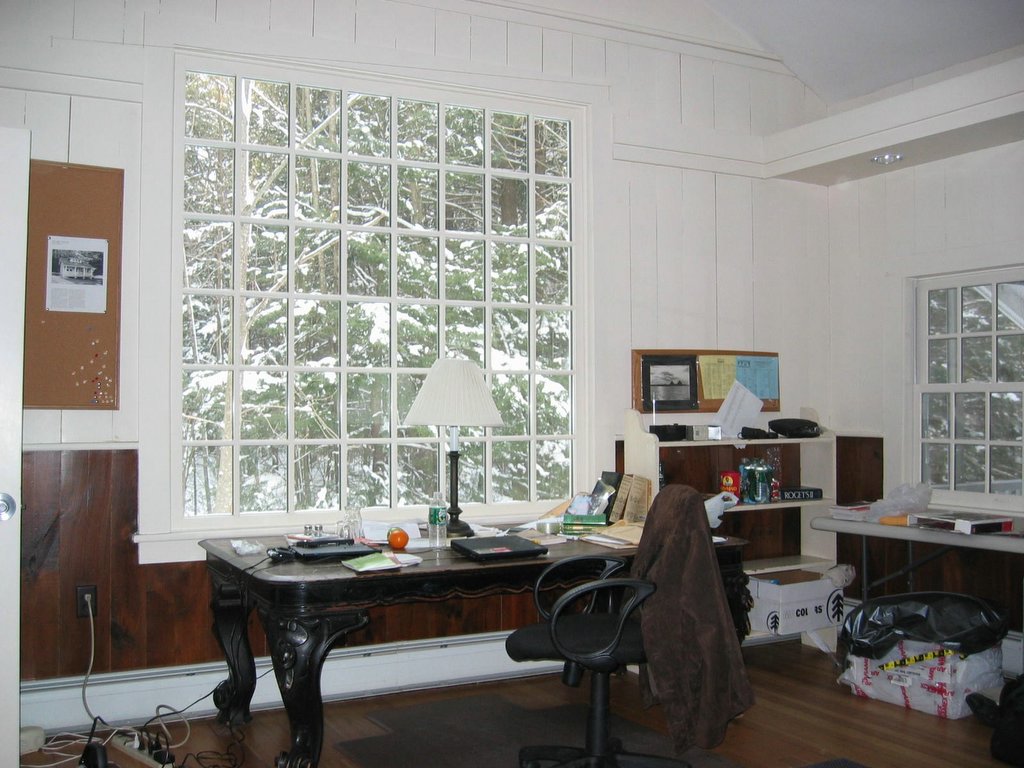
My friend Neil has been at the MacDowell Colony in New Hampshire for the past few weeks. I was curious what it looked like, so he sent me these photos.
I think I could get a lot of writing done here, too. The cottage looks cozy in winter. The staff brings you your lunch as well. No care, no worries.

A Worthy Book Contest
The second annual Tournament of Books sponsored by Powell's Books is gearing up. The contest organizers have announced this year’s judges, which include those with deep literary connections such as Brigid Hughes, the editor of Public Space and former editor of Paris Review – and those without – such as Nell James, a 17 year old progressive rock musician. Lit bloggers Maud Newton, Mark Sarvas, and Jessa Crispin will also serve as judges.
Sixteen books will compete against one another for the grand prize. Each book will be paired against another and the winner will continue to the next bracket until it’s winnowed down to a final two.. and then a winner. For example, Jonathan Safer Froer’s book Extremely Loud and Incredibly Close will compete against The History of Love, written by his wife Nicole Krauss. (The critics sort of compared them anyway in articles; now they will actually go head to head).
What I love about this contest is you get to see what “ordinary” people think about the books they read. You get to cheer for the books you’ve read and hiss at those you know nothing about. Sort of like the Oscars.
Sixteen books will compete against one another for the grand prize. Each book will be paired against another and the winner will continue to the next bracket until it’s winnowed down to a final two.. and then a winner. For example, Jonathan Safer Froer’s book Extremely Loud and Incredibly Close will compete against The History of Love, written by his wife Nicole Krauss. (The critics sort of compared them anyway in articles; now they will actually go head to head).
What I love about this contest is you get to see what “ordinary” people think about the books they read. You get to cheer for the books you’ve read and hiss at those you know nothing about. Sort of like the Oscars.
Saturday, March 04, 2006
A Grotto Night to Remember
After spending 3 days in Big Sur looking out at a beautiful Pacific Ocean (and dodging hail, rain, thunder and lightening) I reentered civilization Friday night with a splash.
The Grotto, the San Francisco writer's cooperative, threw itself a big party to celebrate its move to new headquarters on Second Street, right near the Bay Bridge and South Park. The new office can only be described as swank. There's a central space painted with bold primary colors surrounded by individual offices. It's a far cry from the early 1990s, when Po Bronson and Ethan Canin came up with the idea of a common office for writers.
Lots of writers, filmmakers, agents and editors came to drink tea from the Samovar Tea House, swill red wine donated by Ravenswood and talk shop. Undoubtedly there were many people I didn't recognize, but I did spot Bronson, Laura Fraser, Tom Barbash, Dan Geller and Dayna Goldfine, who did the acclaimed documentary Ballets Russes, Connie Hale, Rachel Howard, Christopher D. Cook, Todd Oppenheimer, Katy Butler, and many more.
There was a small but loyal turnout from my writing group, North24th. Allison Hoover Bartlett from the group just joined the Grotto. Katherine Neilan, Jill Storey, and I came to cheer her on.
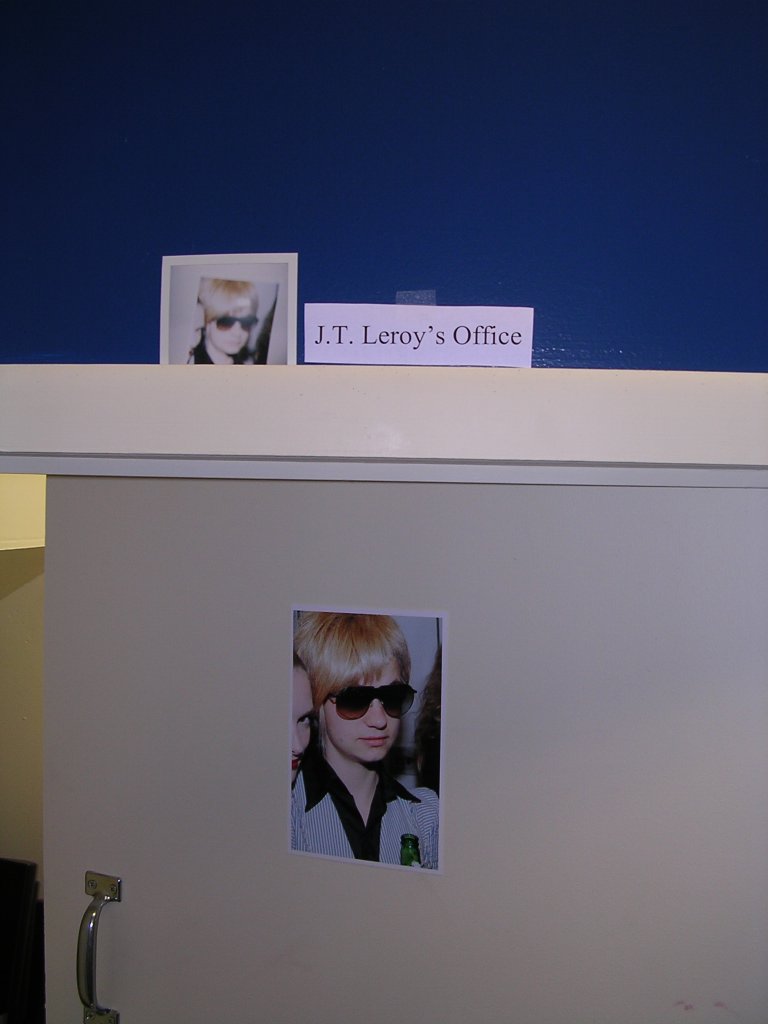
Apparently, J.T. LeRoy stopped in for a moment, but then disappeared into the men's (women's? ) bathroom.
The Grotto, the San Francisco writer's cooperative, threw itself a big party to celebrate its move to new headquarters on Second Street, right near the Bay Bridge and South Park. The new office can only be described as swank. There's a central space painted with bold primary colors surrounded by individual offices. It's a far cry from the early 1990s, when Po Bronson and Ethan Canin came up with the idea of a common office for writers.
Lots of writers, filmmakers, agents and editors came to drink tea from the Samovar Tea House, swill red wine donated by Ravenswood and talk shop. Undoubtedly there were many people I didn't recognize, but I did spot Bronson, Laura Fraser, Tom Barbash, Dan Geller and Dayna Goldfine, who did the acclaimed documentary Ballets Russes, Connie Hale, Rachel Howard, Christopher D. Cook, Todd Oppenheimer, Katy Butler, and many more.
There was a small but loyal turnout from my writing group, North24th. Allison Hoover Bartlett from the group just joined the Grotto. Katherine Neilan, Jill Storey, and I came to cheer her on.
Apparently, J.T. LeRoy stopped in for a moment, but then disappeared into the men's (women's? ) bathroom.
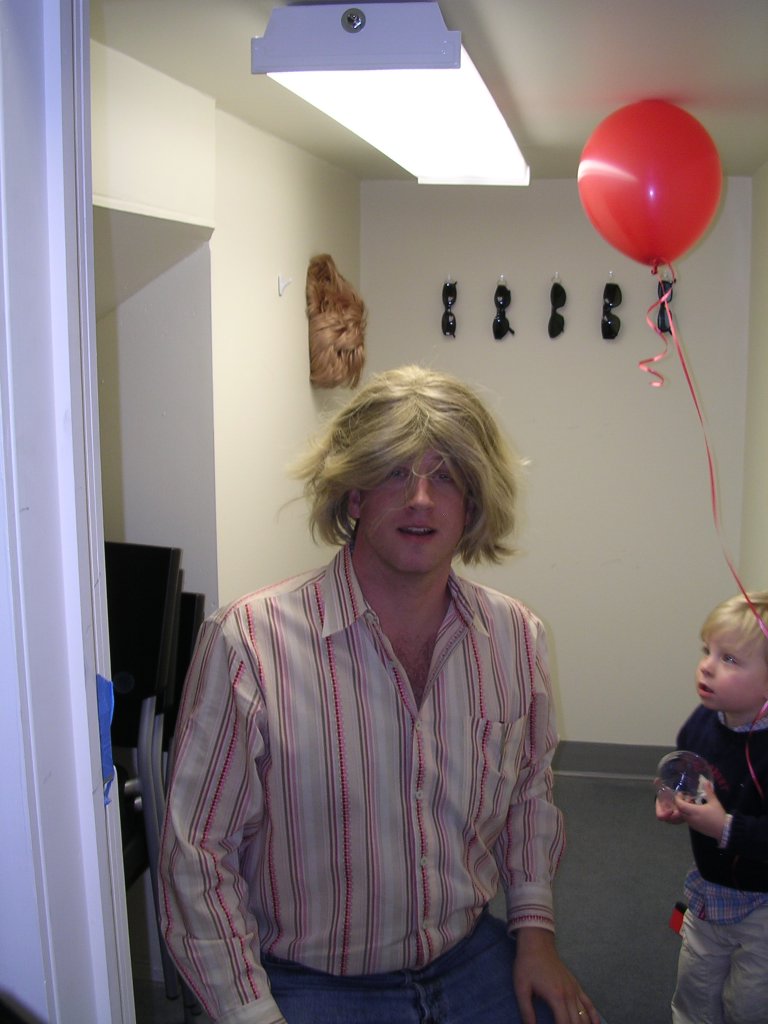
 Grottoing from Left to Right: Kathryn Ma, whose short stories have appeared in The ThreePenny Review and Kalliope; Danielle Svetcov, a writer and an agent for the Levine Greenberg Literary Agency; Jill Storey, whose work has appeared in Salon and on KQED's Perspectives; and Allison Hoover Bartlett, a Grottoite whose most recent piece on a book thief appeared in San Francisco Magazine.

Wednesday, March 01, 2006
Long Silence ....
I have been traveling so much – to Sonoma, Tahoe, and now to Big Sur – that I haven’t had time to post anything on Ghost Word. It’s interesting to see how I can be so consumed by blogging, and then so alternately disinterested. It’s almost an all-or-nothing proposition.
I’ll be back next week and have no more travel plans and will resume my forays into the world of books and writing.
I’ll be back next week and have no more travel plans and will resume my forays into the world of books and writing.
Friday, February 24, 2006
Malcolm Gladwell
Has blogging reached the tipping point? Who knows, but the auteur himself, Malcolm Gladwell, has just started a blog. (via Bookslut)
David Kipen
Mark Sarvas has an interesting interview with David Kipen, the former Chronicle book critic who now serves as the director of literature for the National Endowment for the Arts. Kipen says the anti-NEA forces that once ruled Congress have quieted and funding is steady. Kipen just wrote his first book, The Schrieber Theory: A Radical Rewrite of American Film Industry, in which he argues that screenwriters, rather than directors, are the real auteurs of film.
Sarvas, who runs the blog The Elegant Variation, out of Los Angeles, posted the interview at the LitBlog Coop, run by a dozen literary bloggers who banded together to draw attention to under-appreciated books. They run a competition four times a year, with a number of the bloggers selecting books they think deserve more attention. The bloggers read the various books and then vote. The first book selected was Kate Atkinson’s Case Histories. This winter, the book is Garner by Kirsten Allio.
The LBC is an interesting experiment; can a group deliberately set out to improve a book’s sales? The LBC does its best to stir up interest and their activities have helped books rise in the Amazon rankings, but so far there has been no breakout book. It’s clear literary bloggers have limited influence.
Honestly, I haven’t run to the bookstore to pick up any of the books recommended by the LBC. I am sure they are worthy, but I am somewhat suspicious of books selected by committee. I’d rather read a single lit blogger’s recommendation and go and get a book. I’m influenced by the blogger’s personality and often know other books he or she has recommended, so I have a compass to guide me.
Sarvas, who runs the blog The Elegant Variation, out of Los Angeles, posted the interview at the LitBlog Coop, run by a dozen literary bloggers who banded together to draw attention to under-appreciated books. They run a competition four times a year, with a number of the bloggers selecting books they think deserve more attention. The bloggers read the various books and then vote. The first book selected was Kate Atkinson’s Case Histories. This winter, the book is Garner by Kirsten Allio.
The LBC is an interesting experiment; can a group deliberately set out to improve a book’s sales? The LBC does its best to stir up interest and their activities have helped books rise in the Amazon rankings, but so far there has been no breakout book. It’s clear literary bloggers have limited influence.
Honestly, I haven’t run to the bookstore to pick up any of the books recommended by the LBC. I am sure they are worthy, but I am somewhat suspicious of books selected by committee. I’d rather read a single lit blogger’s recommendation and go and get a book. I’m influenced by the blogger’s personality and often know other books he or she has recommended, so I have a compass to guide me.
Thursday, February 23, 2006
A Cross between Idolizing and Hating
What’s the fine line between idolizing someone and hating them? What does it mean when someone famous, someone you have never met, takes up too much real estate in your brain? Washington Post writer Ann Hornaday calls it idolspize and she applies her theories to Susan Orlean, author of The Orchid Thief and many other well-told tales.
Do you idolspize?
Or, more to the point, whom do you idolspize?
THEN …..
I idolspize Susan Orlean.
Please understand: I adore Susan Orlean and begrudge her nothing, not the New Yorker gig, the books, the close-up-ready face. Not even the two great movies based on her articles -- "Adaptation" and "Blue Crush" -- that opened the same year . Still, throughout the ensuing weekend, my mind obsessively returned to the same thoughts, the mewling laments of a puny inquisitor: She's got the career, the looks, the romance, the kid. Did she have to get the perfect house, too? Must her happiness, however justified, be so in-your-face? Must she be so promiscuous in her bliss?
We all have them, those close friends, colleagues, casual acquaintances or complete strangers whose lives and careers exist -- it seems to us -- solely as a rebuke to our own. We respect them, admire them from afar, maybe even love them -- but with a twinge of . . . what exactly? Jealousy? Envy? White-knuckled rage? They're the people who are constantly reminding us that we'll never quite measure up. They're the valedictorians to our salutatorians, the bestsellers to our mid-listers, the mid-listers to our never-published, the homecoming queens to our also-rans. They seem to have sprung fully formed from our ugliest competitive streaks, our egos at their most fragile, our deepest self-loathing. They are our own squandered potential, fully realized.
THIS IS NO SURPRISE:
PUBLISHER AXES FREY DEAL
I-MADE-it-up memoirist James Frey's new megabucks book deal has exploded into a million little pieces. Frey had a deal with his current publisher, Penguin-owned imprint Riverhead, for two more books, which was inked just before it was scandalously revealed last month that Frey had fabricated much of his story. The reputed new seven-figure contract included Frey's "first" novel, a "multi-voiced, multi-threaded story of contemporary Los Angeles," slated for publication in fall 2007. But a publishing source told PAGE SIX's Jared Paul Stern that Riverhead decided the author was too much of a liability and has just nixed the deal after much discussion. "That is correct, and we have no comment," Frey's rep says.
Earlier this month, Frey's literary agent Kassie Evashevski, who negotiated the deal, dropped him citing "broken trust." Meanwhile, Warner Bros. is re-evaluating its big screen adaptation of Frey's faux memoir "A Million Little Pieces." But none of the negativity has had much impact on sales of the book, which recently hit the 3 million mark.
Do you idolspize?
Or, more to the point, whom do you idolspize?
THEN …..
I idolspize Susan Orlean.
Please understand: I adore Susan Orlean and begrudge her nothing, not the New Yorker gig, the books, the close-up-ready face. Not even the two great movies based on her articles -- "Adaptation" and "Blue Crush" -- that opened the same year . Still, throughout the ensuing weekend, my mind obsessively returned to the same thoughts, the mewling laments of a puny inquisitor: She's got the career, the looks, the romance, the kid. Did she have to get the perfect house, too? Must her happiness, however justified, be so in-your-face? Must she be so promiscuous in her bliss?
We all have them, those close friends, colleagues, casual acquaintances or complete strangers whose lives and careers exist -- it seems to us -- solely as a rebuke to our own. We respect them, admire them from afar, maybe even love them -- but with a twinge of . . . what exactly? Jealousy? Envy? White-knuckled rage? They're the people who are constantly reminding us that we'll never quite measure up. They're the valedictorians to our salutatorians, the bestsellers to our mid-listers, the mid-listers to our never-published, the homecoming queens to our also-rans. They seem to have sprung fully formed from our ugliest competitive streaks, our egos at their most fragile, our deepest self-loathing. They are our own squandered potential, fully realized.
THIS IS NO SURPRISE:
PUBLISHER AXES FREY DEAL
I-MADE-it-up memoirist James Frey's new megabucks book deal has exploded into a million little pieces. Frey had a deal with his current publisher, Penguin-owned imprint Riverhead, for two more books, which was inked just before it was scandalously revealed last month that Frey had fabricated much of his story. The reputed new seven-figure contract included Frey's "first" novel, a "multi-voiced, multi-threaded story of contemporary Los Angeles," slated for publication in fall 2007. But a publishing source told PAGE SIX's Jared Paul Stern that Riverhead decided the author was too much of a liability and has just nixed the deal after much discussion. "That is correct, and we have no comment," Frey's rep says.
Earlier this month, Frey's literary agent Kassie Evashevski, who negotiated the deal, dropped him citing "broken trust." Meanwhile, Warner Bros. is re-evaluating its big screen adaptation of Frey's faux memoir "A Million Little Pieces." But none of the negativity has had much impact on sales of the book, which recently hit the 3 million mark.
Saturday, February 18, 2006
Scenes from the wine country

I was lucky enough to spend a few days in the wine country where the mustard was blooming and the temperature hovered around 70 degrees. I'm off again to the snow, where it will be cold and grey. Ah, the extremes of winter in California!
A few things I have enjoyed recently:
Mark Pritchard interviews Meredith Maran, an East Bay writer who is writing a novel after 10 books of non-fiction. Meredith has an essay in the new anthology Why I'm Still Married which is a delightful account of meeting her French lover after thinking love would never strike her again.
The Bancroft Library is celebrating 100 years on the Berkeley campus with a fantastic exhibit at the Berkeley Art Museum. This is a must-see. There is the gold nugget that started the Gold Rush, old maps of California, letters from people like Thomas Jefferson, Theodore Roosevelt, William Randolph Hearst, pictures of San Francisco in the Gold Rush, after the earthquake and fire, and much more.
I went to the opening reception and was looking at a picture of Black Panther Huey Newton. It was taken when he was young and gorgeous. His chest rippled and his skin was smooth. Just then Kathleen Cleaver, the former wife of Eldridge Cleaver and an early member of the Panthers, walked up. I commented on how charismatic Newton looked. She agreed but said she always was more attracted to "bad boys" and that's why she hooked up with Eldridge!
Kathleen Cleaver, who now works at Yale, came to Berkeley to talk at a two-day conference sponsored by the Bancroft Library. It was almost a mini-review of the West, as the talks ranged from the Mexican rule to biotechnology. I think this library --- which also has a wonderful exhibit of the San Francisco earthquake on view at Doe Library -- is one of the region's most amazing resources.
Sunday, February 12, 2006
The New Bestsellers
There are some interesting developments in the San Francisco Chronicle’s bestseller list this week.
The most apparent is the meteoric rise of Ayelet Waldman’s new novel Love and Other Impossible Pursuits to position #2, a week after its release. It’s clear the Bay Area loves Ayelet. She’s invited to speak everywhere and semi-specializes in luncheons with dozens of women in the audience. Her controversial essay on loving her husband, Michael Chabon, more than her children, outraged sexy mothers everywhere, but it appears to have catapulted her from regional to national stature.
But how is she developing as a writer? Her Mommy Track mysteries are like little bon-bons, sweet, but not filling. Daughter’s Keeper, her last novel, was more ambitious, but not entirely successful. Many people I know liked it; I felt its pace was hurried and its tone too commercial.
Love and Other Impossible Pursuits , which dwells on "maternal ambivalence," the theme Ayelet explored in her essay, got a good review Sunday in the New York Times. The article took up a half-page, which is a compliment and a testament to how much more famous Ayelet has become; Daughter’s Keeper only got a short blurb in the Times. While the reviewer did use those dreaded words “chick-lit” in connection with the book, she also liked the book a lot. Others have disliked the book with the same fervency.
Ayelet will be all around the Bay Area this week. She’ll be at Cody’s Books on Telegraph on Wednesday evening and Rakestraw Books in Danville on Thursday, as well as other venues in the weeks to come.
IN ANOTHER INTERESTING DEVELOPMENT …. Liz Perle’s book, Money, A Memoir, is at #7 on the Chronicle’s non-fiction list. Clearly, her book about how women struggle with money has touched a nerve. Liz’s press has been great as well: Time and People Magazine did features on her and she appeared on some of the morning shows. Perle will be at A Great Good Place for Books in Oakland on March 9.
I AM OFF AGAIN for a few days to write, write, write.
February 15th marks the one year anniversary of Ghost Word. It’s been great fun to throw my ideas on-line, showcase books and authors I like, and “meet” so many other bloggers. But it feels appropriate to spend the anniversary working on my book, which is an even greater labor of love.
I leave you with a link to ReadingWritingLiving, the blog of Bay Area author Susan Ito. In the past few weeks, Ito has been writing about leaving her children to go on writing retreats and the tension between responsibility to one’s self as a writer and responsibility to family. I have found it very interesting.
The most apparent is the meteoric rise of Ayelet Waldman’s new novel Love and Other Impossible Pursuits to position #2, a week after its release. It’s clear the Bay Area loves Ayelet. She’s invited to speak everywhere and semi-specializes in luncheons with dozens of women in the audience. Her controversial essay on loving her husband, Michael Chabon, more than her children, outraged sexy mothers everywhere, but it appears to have catapulted her from regional to national stature.
But how is she developing as a writer? Her Mommy Track mysteries are like little bon-bons, sweet, but not filling. Daughter’s Keeper, her last novel, was more ambitious, but not entirely successful. Many people I know liked it; I felt its pace was hurried and its tone too commercial.
Love and Other Impossible Pursuits , which dwells on "maternal ambivalence," the theme Ayelet explored in her essay, got a good review Sunday in the New York Times. The article took up a half-page, which is a compliment and a testament to how much more famous Ayelet has become; Daughter’s Keeper only got a short blurb in the Times. While the reviewer did use those dreaded words “chick-lit” in connection with the book, she also liked the book a lot. Others have disliked the book with the same fervency.
Ayelet will be all around the Bay Area this week. She’ll be at Cody’s Books on Telegraph on Wednesday evening and Rakestraw Books in Danville on Thursday, as well as other venues in the weeks to come.
IN ANOTHER INTERESTING DEVELOPMENT …. Liz Perle’s book, Money, A Memoir, is at #7 on the Chronicle’s non-fiction list. Clearly, her book about how women struggle with money has touched a nerve. Liz’s press has been great as well: Time and People Magazine did features on her and she appeared on some of the morning shows. Perle will be at A Great Good Place for Books in Oakland on March 9.
I AM OFF AGAIN for a few days to write, write, write.
February 15th marks the one year anniversary of Ghost Word. It’s been great fun to throw my ideas on-line, showcase books and authors I like, and “meet” so many other bloggers. But it feels appropriate to spend the anniversary working on my book, which is an even greater labor of love.
I leave you with a link to ReadingWritingLiving, the blog of Bay Area author Susan Ito. In the past few weeks, Ito has been writing about leaving her children to go on writing retreats and the tension between responsibility to one’s self as a writer and responsibility to family. I have found it very interesting.
Wednesday, February 08, 2006
Truman Capote
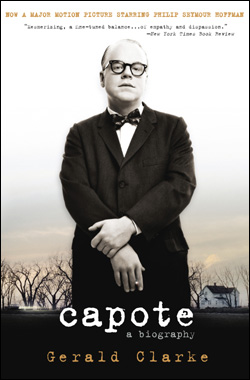
I was so captivated by the movie Capote (even though a mess-up at the theater meant I missed the first five minutes) that I decided to read the book it was based on, Capote by Gerald Clarke. After all, I reasoned, I am writing a biography and I might learn something from the book’s structure and rhythm.
Well, that was an understatement. The book is a marvel, an I-can’t-put-it-down masterpiece of 540 pages, each dripping with delicious and sometimes excruciating details about ruman Capote.
I remember when he died in 1984. By that point Capote was an overweight, pill and alcohol addicted mess, in and out of hospitals. It had been 20 years since the release of In Cold Blood, his masterpiece, so at the time I wasn’t particularly saddened by his death.
But I clearly did not fully appreciate Capote’s brilliance. As Clarke demonstrates, for most of his life Capote was a disciplined, driven writer. While he enjoyed fancy cocktail parties with the glitterati in New York and on the yachts of people like Aristotle Onassis and Marella Agnelli, he spent most of his time holed up in spartan island houses typing away. He was truly dedicated to his craft and was in complete command of his language and style.
His wrote in almost every medium. While he made his mark with short, almost Gothic short stories, his novels, like Breakfast at Tiffany’s, were admired. He wrote travel pieces for Vogue, a much-talked about profile of the reclusive Marlon Brando for The New Yorker, and numerous other articles. Every time he came out with new work, it made a stir.
Of course part of his popularity came from his personality. As Philip Seymour Hoffman so ably demonstrates in the movie, Capote was effeminate and spoke in a high pitched tone. He was also a great listener and soon found that the world’s most social women – Babe Paley, Lee Radziwall, CZ Guest – were devoted to him. All that changed when he published a short story that parodied their lifestyle. He was cast out, decried as a traitor, and that was the start of his downward spiral.
The book highlights an era when writers were a dominant part of American culture, when what they thought, said, and wrote about was eagerly anticipated. There are a few such writers in the country today, but their role, as everyone knows, has been eclipsed by the rise of celebrities in every other form – the movies, the sports fields, the world of music.
As for learning how to write a biography from this book, well, I can only dream. Clarke, a former reporter for Time Magazine, spent almost 10 years in Capote’s company and interviewed hundreds of his friends. He got amazing material and wrote a gripping book with it. Capote spent 13 weeks in 1988 on the New York Times bestseller list – the longest time ever for a literary biography. It has just been reissued in paperback to coincide with the movie. Just as Capote, the movie, is a must-see, Capote the book is a must-read.
Sunday, February 05, 2006
Watch What the Los Angeles Times is Doing
David Ulin, the new editor of the Los Angeles Book Review, has a thoughtful – and right on – essay about the line between truth and fiction in memoir. He points out that a number of accomplished memoirists – Anne Dillard, Vivian Gornick, and Hunter S. Thompson, have admitted over the years that they massaged the truth to reach something deeper in their books. But what James Frey did still stands out.
“For writers like Dillard, Gornick and Thompson, what's at issue is emotional truth, the need to re-create the sensibility, the tenor, of an experience in a reader's mind. This is the essence of literature, which like all art, operates at a level beyond the rational, according to rules of its own. In literature, truth is not so much known as it is felt, and empathy is as important as understanding. In literature, the logic of the story can sometimes trump the logic of the world. If this sounds disingenuous, it's not meant to — on the contrary, it's what makes art resonate.
To tell a story is in a very real way to cast off the veils of genre and simply see what works. That's particularly the case in the nebulous category known as creative nonfiction, which exists somewhere between truth and invention, in a territory that's still taking shape. You'd be hard pressed to find a work of creative nonfiction that didn't involve some degree of reinvention, whether in the construction of scenes (description, dialogue) or the interpretive filter every writer brings to his or her version of events. Is this dishonest? No more so than memory, with its vagaries and false turns: a narrow, flawed and ultimately subjective window on the world.
For a lot of people, the very phrase "creative nonfiction" is an oxymoron. There's nothing creative, they would say, about the truth. But the more you think about it, the more such an argument becomes specious or (worse) unsophisticated, a misunderstanding of how creative writing works. The decision to tell a story is a fictionalizing impulse: to take the chaos of reality and shape it, looking for order, meaning, where none inherently exists. This is as true of memoir as it is of the novel. Genre distinctions aside, most writers try to tell the truth as they see it, to reveal something lasting about their experience. Frey, we now know, had other intentions; he lied, pure and simple, and for reasons that had nothing to do with literature. It was not emotional truth that he was after, but emotional untruth, a willful obfuscation in the interest of appearing to be something he was not. Still, for all the pathological aspects of his story, it does touch on more important — and more interesting — questions, reminding us that every piece of writing is, at bottom, a construction, an attempt to frame a moment and present it in cohesive form.”
In another LA Times matter, the new magazine West was unveiled on Sunday. As a California writer, I am excited about West’s ambition to cover the entire state, to engage its history and future and run pieces that illuminate the puzzle that is California.
Rick Wartzman is the new editor, and he brings the eye of a journalist and author to his position. I met him briefly last summer at the Squaw Valley Community of Writers and was impressed by his willingness to try new things. Next week, Berkeley author Carla Shrapreau will have a piece on violins – their creation and the black market for stolen ones. She brought the piece to be workshopped at Squaw. Wartzman was assigned to edit and comment on it and he liked it so much he bought it on the spot. That’s what I call a good editor. Here’s a bit from his editor’s note.
"The state is an immense canvas, and we aim to capture it in the grandest sense imaginable: our dreamers and pragmatists; our mountains, deserts and coast; our endless urban sprawl; Hollywood, Silicon Valley and the biggest farm belt in the nation in between; our multiethnic stew; the challenges brought on by our exploding population; style, design and fashion; music and literature; and on and on and on....
From time to time, we'll also cover subjects that shape the larger Western region. And we'll write from locations that practically seem like suburbs, given their nexus to California. Think Las Vegas, the Pacific Rim, Latin America."
I am a fan of the San Francisco Chronicle, but both its magazine and book review section are on life support. The poor Chronicle is bleeding money – it lost more readers last year than any other newspaper – and it clearly isn’t dedicating many resources to the sections of the paper it deems non-essential. That said, the paper had a great piece this Sunday on certain violent police officers. I also liked the recent series on how global warming is affecting the Pacific Rim.
“For writers like Dillard, Gornick and Thompson, what's at issue is emotional truth, the need to re-create the sensibility, the tenor, of an experience in a reader's mind. This is the essence of literature, which like all art, operates at a level beyond the rational, according to rules of its own. In literature, truth is not so much known as it is felt, and empathy is as important as understanding. In literature, the logic of the story can sometimes trump the logic of the world. If this sounds disingenuous, it's not meant to — on the contrary, it's what makes art resonate.
To tell a story is in a very real way to cast off the veils of genre and simply see what works. That's particularly the case in the nebulous category known as creative nonfiction, which exists somewhere between truth and invention, in a territory that's still taking shape. You'd be hard pressed to find a work of creative nonfiction that didn't involve some degree of reinvention, whether in the construction of scenes (description, dialogue) or the interpretive filter every writer brings to his or her version of events. Is this dishonest? No more so than memory, with its vagaries and false turns: a narrow, flawed and ultimately subjective window on the world.
For a lot of people, the very phrase "creative nonfiction" is an oxymoron. There's nothing creative, they would say, about the truth. But the more you think about it, the more such an argument becomes specious or (worse) unsophisticated, a misunderstanding of how creative writing works. The decision to tell a story is a fictionalizing impulse: to take the chaos of reality and shape it, looking for order, meaning, where none inherently exists. This is as true of memoir as it is of the novel. Genre distinctions aside, most writers try to tell the truth as they see it, to reveal something lasting about their experience. Frey, we now know, had other intentions; he lied, pure and simple, and for reasons that had nothing to do with literature. It was not emotional truth that he was after, but emotional untruth, a willful obfuscation in the interest of appearing to be something he was not. Still, for all the pathological aspects of his story, it does touch on more important — and more interesting — questions, reminding us that every piece of writing is, at bottom, a construction, an attempt to frame a moment and present it in cohesive form.”
In another LA Times matter, the new magazine West was unveiled on Sunday. As a California writer, I am excited about West’s ambition to cover the entire state, to engage its history and future and run pieces that illuminate the puzzle that is California.
Rick Wartzman is the new editor, and he brings the eye of a journalist and author to his position. I met him briefly last summer at the Squaw Valley Community of Writers and was impressed by his willingness to try new things. Next week, Berkeley author Carla Shrapreau will have a piece on violins – their creation and the black market for stolen ones. She brought the piece to be workshopped at Squaw. Wartzman was assigned to edit and comment on it and he liked it so much he bought it on the spot. That’s what I call a good editor. Here’s a bit from his editor’s note.
"The state is an immense canvas, and we aim to capture it in the grandest sense imaginable: our dreamers and pragmatists; our mountains, deserts and coast; our endless urban sprawl; Hollywood, Silicon Valley and the biggest farm belt in the nation in between; our multiethnic stew; the challenges brought on by our exploding population; style, design and fashion; music and literature; and on and on and on....
From time to time, we'll also cover subjects that shape the larger Western region. And we'll write from locations that practically seem like suburbs, given their nexus to California. Think Las Vegas, the Pacific Rim, Latin America."
I am a fan of the San Francisco Chronicle, but both its magazine and book review section are on life support. The poor Chronicle is bleeding money – it lost more readers last year than any other newspaper – and it clearly isn’t dedicating many resources to the sections of the paper it deems non-essential. That said, the paper had a great piece this Sunday on certain violent police officers. I also liked the recent series on how global warming is affecting the Pacific Rim.
Wednesday, February 01, 2006
Frey, Frey, Frey and more Frey, and yes a little Talese
Nan Talese was apparently taken by surprise when she appeared on Oprah. She thought she was there to talk about “truth” in general, not her client, James Frey.
Frey’s agent has dropped him.
His contrite author’s note, which will appear in all new editions of A Million Little Pieces, is here:
"During the process of writing the book, I embellished many details about my past experiences, and altered others in order to serve what I felt was the greater purpose of the book. I sincerely apologize to those readers who have been disappointed by my actions...."
"As I wrote, I worked primarily from memory. I also used supporting documents, such as medical records, therapists' notes, and personal journals, when I had them, and when they were relevant...."
"I altered events and details all the way through the book. Some of those include my role in a train accident that killed a girl from my school. While I was not, in real-life, directly involved in the accident, I was profoundly affected by it. Others involved jail time I served, which in the book is three months, but which in reality was only several hours, and certain criminal events, including an arrest in Ohio, which was embellished. There has been much discussion, and dispute, about a scene in the book involving a root-canal procedure that takes place without anesthesia. I wrote that passage from memory, and have medical records that seem to support it. My account has been questioned by the treatment facility, and they believe my memory may be flawed...."
"I made other alterations in my portrayal of myself, most of which portrayed me in ways that made me tougher and more daring and more aggressive than in reality I was, or I am.... My mistake, and it is one I deeply regret, is writing about the person I created in my mind to help me cope, and not the person who went through the experience."
NOW THAT everyone is getting flogged publicly, Ellen Emry Heltzel raises the question whether there is a conflict of interest when a journalist has a book deal? In an article provocatively titled “Another Thing Rotten in Bookland: Reporters by Day/Book-Floggers by Night “ she questions how reporters/authors treat their information. Where is the juiciest information first released? In the newspaper or on television or in the book? Is it seemly to promote your own product on your news show?
Frey’s agent has dropped him.
His contrite author’s note, which will appear in all new editions of A Million Little Pieces, is here:
"During the process of writing the book, I embellished many details about my past experiences, and altered others in order to serve what I felt was the greater purpose of the book. I sincerely apologize to those readers who have been disappointed by my actions...."
"As I wrote, I worked primarily from memory. I also used supporting documents, such as medical records, therapists' notes, and personal journals, when I had them, and when they were relevant...."
"I altered events and details all the way through the book. Some of those include my role in a train accident that killed a girl from my school. While I was not, in real-life, directly involved in the accident, I was profoundly affected by it. Others involved jail time I served, which in the book is three months, but which in reality was only several hours, and certain criminal events, including an arrest in Ohio, which was embellished. There has been much discussion, and dispute, about a scene in the book involving a root-canal procedure that takes place without anesthesia. I wrote that passage from memory, and have medical records that seem to support it. My account has been questioned by the treatment facility, and they believe my memory may be flawed...."
"I made other alterations in my portrayal of myself, most of which portrayed me in ways that made me tougher and more daring and more aggressive than in reality I was, or I am.... My mistake, and it is one I deeply regret, is writing about the person I created in my mind to help me cope, and not the person who went through the experience."
NOW THAT everyone is getting flogged publicly, Ellen Emry Heltzel raises the question whether there is a conflict of interest when a journalist has a book deal? In an article provocatively titled “Another Thing Rotten in Bookland: Reporters by Day/Book-Floggers by Night “ she questions how reporters/authors treat their information. Where is the juiciest information first released? In the newspaper or on television or in the book? Is it seemly to promote your own product on your news show?
Tuesday, January 31, 2006
Things About Books That I Love
One of the reasons I started to blog last year (and it will be a year Feb. 15) was because I thoroughly enjoyed a new contest called A Tournament of Books.
A group of book lovers, including the folks at Powells’ Books in Portland and assorted bloggers, created a round robin contest that pitted 16 books directly against one another. (It was patterned after the NCAA basketball tournament) Two reviewers would read two books and argue in print which one was better. The winning book would go to the next round to compete again. The 2005 winner? Well, I can’t quite remember and my research on Google didn’t tell me. It was either David Mitchell’s Cloud Atlas or Phillip Roth’s The Plot Against America.
What made the contest particularly fun were the reviewers, who were not necessarily erudite or well-read. So it was like a slice of America. You had bibliophiles, music lovers, readers in their 40s and in their 20s, in short, a diverse group of judges.
I first found out about the contest through an article in the New York Times. I couldn't wait to get back to my computer and every day found me eagerly looking for new critiques. I was so enchanted by the discussions and the fact that they were taking place outside of normal media channels. The Tournament convinced me of the power of blogging and although history wasn't made, I did go on to start Ghost Word.
Well, I just found out after reading The Elegant Variation that there will be a Year 2 of this tournament, starting in March. The organizers have just announced the books that will be read in competition. I can't wait for it to begin.
ANOTHER THING I LOVE Alan Rinzler is the executive editor of Jossey-Bass, a San Francisco-based publishing house. Rinzler has worked on many interesting books during his long career and even offers his editorial services for hire. He’s edited Toni Morrison, Hunter Thompson, Tom Robbins, Jerzy Kosinski, Robert Ludlum, Clive Cussler, Dee Brown, Vine Deloria Jr, Claude Brown, Shirley MacLaine, Andy Warhol, Bob Dylan and others. For the last six years, Rinzler has offered a free three-session course at Cody’s Books on how to publish a book From Cody’s website.
“ALAN RINZLER asks ARE YOU GOOD ENOUGH TO BE PUBLISHED? The sixth (6th!) annual three-session symposium -- February 5, March 5, and April 2nd -- on what it takes to get your book published, providing participants with frank feedback and honest evaluation of your proposal or sample manuscript from a publishing veteran, is back. We'll discuss how to research and prepare an idea -- fiction or nonfiction -- and guidelines for revision if there's a realistic chance of success.
If you'd like your proposal or manuscript to be considered before the group during the first session on February 5, send ahead no more than 15 pages to arinzler@jbp.com or hard copy to Alan Rinzler, Executive Editor, Jossey-Bass/Wiley, 989 Market Street, SF, CA 94103. Otherwise, just come! No reservations are necessary.”
This is not a course you have to sign up for. You can show up. It’s worth just hearing Rinzler talk. It starts this Sunday, Feb. 5 at 3 pm at Cody’s on Telegraph.
A group of book lovers, including the folks at Powells’ Books in Portland and assorted bloggers, created a round robin contest that pitted 16 books directly against one another. (It was patterned after the NCAA basketball tournament) Two reviewers would read two books and argue in print which one was better. The winning book would go to the next round to compete again. The 2005 winner? Well, I can’t quite remember and my research on Google didn’t tell me. It was either David Mitchell’s Cloud Atlas or Phillip Roth’s The Plot Against America.
What made the contest particularly fun were the reviewers, who were not necessarily erudite or well-read. So it was like a slice of America. You had bibliophiles, music lovers, readers in their 40s and in their 20s, in short, a diverse group of judges.
I first found out about the contest through an article in the New York Times. I couldn't wait to get back to my computer and every day found me eagerly looking for new critiques. I was so enchanted by the discussions and the fact that they were taking place outside of normal media channels. The Tournament convinced me of the power of blogging and although history wasn't made, I did go on to start Ghost Word.
Well, I just found out after reading The Elegant Variation that there will be a Year 2 of this tournament, starting in March. The organizers have just announced the books that will be read in competition. I can't wait for it to begin.
ANOTHER THING I LOVE Alan Rinzler is the executive editor of Jossey-Bass, a San Francisco-based publishing house. Rinzler has worked on many interesting books during his long career and even offers his editorial services for hire. He’s edited Toni Morrison, Hunter Thompson, Tom Robbins, Jerzy Kosinski, Robert Ludlum, Clive Cussler, Dee Brown, Vine Deloria Jr, Claude Brown, Shirley MacLaine, Andy Warhol, Bob Dylan and others. For the last six years, Rinzler has offered a free three-session course at Cody’s Books on how to publish a book From Cody’s website.
“ALAN RINZLER asks ARE YOU GOOD ENOUGH TO BE PUBLISHED? The sixth (6th!) annual three-session symposium -- February 5, March 5, and April 2nd -- on what it takes to get your book published, providing participants with frank feedback and honest evaluation of your proposal or sample manuscript from a publishing veteran, is back. We'll discuss how to research and prepare an idea -- fiction or nonfiction -- and guidelines for revision if there's a realistic chance of success.
If you'd like your proposal or manuscript to be considered before the group during the first session on February 5, send ahead no more than 15 pages to arinzler@jbp.com or hard copy to Alan Rinzler, Executive Editor, Jossey-Bass/Wiley, 989 Market Street, SF, CA 94103. Otherwise, just come! No reservations are necessary.”
This is not a course you have to sign up for. You can show up. It’s worth just hearing Rinzler talk. It starts this Sunday, Feb. 5 at 3 pm at Cody’s on Telegraph.
Monday, January 30, 2006
Wendy Wasserstein
Playwright Wendy Wasserstein died Monday of cancer at age 55. She was a single mother and leaves behind her 6 or 7 year old daughter. (via Blog of a Bookslut)
The Lure of the Memoir
Oprah Winfrey chewed out mega-publisher Nan Talese on Thursday, but the reception in New York has been different.
When Talese walked into her office at Doubleday after flying back from Chicago, she was greeted with a standing ovation, according to the Wall Street Journal. The chairman of her company, Random House, called her up. She also received more than 500, mostly supportive, e-mails about her appearance on Oprah and the James Frey dust-up.
Is this not the case of an ostrich with its head in the sand? Why are congratulations being passed around? The publishing industry made a big mistake with James Frey’s book – and it looks like they are putting their own positive and distorted spin on the whole mess.
SPEAKING OF MEMOIRS, Edward Guthmann has an article on Kate Braverman in Monday’s San Francisco Chronicle. Braverman, one of the most iconoclastic writers of the past 20 years, has an “accidental memoir,” a linked collection of essays and recollections called Frantic Transmissions to and from Los Angeles. It deals with Braverman’s time in Los Angeles – she grew up there and spent some of her adult years there – seen from a distance.
I’ve met Braverman a few times at a writers’ group and at every encounter I have been fascinated and entertained by the words coming out of her mouth. She is highly dramatic, but her sentences are like poetry: sharp, memorable, and compelling. Braverman will give a reading from her new book at 7 pm Thursday at City Lights Bookstore in San Francisco.
The San Francisco Examiner asked local writers to provide the names of their favorite authors. (via Moorish Girl)
When Talese walked into her office at Doubleday after flying back from Chicago, she was greeted with a standing ovation, according to the Wall Street Journal. The chairman of her company, Random House, called her up. She also received more than 500, mostly supportive, e-mails about her appearance on Oprah and the James Frey dust-up.
Is this not the case of an ostrich with its head in the sand? Why are congratulations being passed around? The publishing industry made a big mistake with James Frey’s book – and it looks like they are putting their own positive and distorted spin on the whole mess.
SPEAKING OF MEMOIRS, Edward Guthmann has an article on Kate Braverman in Monday’s San Francisco Chronicle. Braverman, one of the most iconoclastic writers of the past 20 years, has an “accidental memoir,” a linked collection of essays and recollections called Frantic Transmissions to and from Los Angeles. It deals with Braverman’s time in Los Angeles – she grew up there and spent some of her adult years there – seen from a distance.
I’ve met Braverman a few times at a writers’ group and at every encounter I have been fascinated and entertained by the words coming out of her mouth. She is highly dramatic, but her sentences are like poetry: sharp, memorable, and compelling. Braverman will give a reading from her new book at 7 pm Thursday at City Lights Bookstore in San Francisco.
The San Francisco Examiner asked local writers to provide the names of their favorite authors. (via Moorish Girl)
Friday, January 27, 2006
James Frey Did It, or Does a Memoir Have to be True?
Since when has memoir been true?
Memoir, as Nan Talese put it on Thursday’s Oprah, is an author’s recollection of what happened. In other words, when a person reconstructs a life, he or she has some latitude to describe it through their particular lens. When I pick up a memoir, I know I am reading a life seen through rose-colored glasses. That’s a given and I read with a certain detached skepticism.
But while there is room to revisit your past in your own way, it is entirely different to make up entire portions of it. It is one thing to write about being visited in bed at age 8 by a family friend and try and describe the sensation of being molested. That is clearly a memory, one colored by pain and grief.
It’s different to write that you spent three months in jail when you actually only spent 3 hours. That is a lie. That is not interpreting your life through your own special lens.
I doubt that James Frey is the only author who has sinned. He just was stupid enough to lie about things that can be easily checked, like the length of a jail sentence. Other popular memoirists have been accused of making things up. Augusten Burroughs is currently the defendant in a defamation suit. The family of the pseudonymous psychiatrist in the book has taken issue with Burrough’s depiction of the man.
“Six members of the Turcotte family, whose patriarch was Dr. Rodolph H. Turcotte, who died in 2000, are suing Burroughs, his agent, and publisher St. Martin's Press in Middlesex Superior Court,” the Boston Globe reported. “The suit demands a public retraction of the book and a public statement that it is fiction and not a memoir. The suit also asks that the publisher be enjoined from continued publication and distribution of the book.”
The publisher is also trying to make sure that no one looks too closely at Burrough’s work, according to the gossip columnist for the New York Post.
“According to New York Post gossip column Page Six, St. Martin’s also added disclaimers to Burroughs’s other books, including Running with Scissors and Dry. The gossip column also went to The Smoking Gun founder Bill Bastone to ask if Burroughs would be the next author to be investigated by the website.”
“Since our Frey investigation, we’ve had dozens and dozens of people writing in to suggest other authors for us to look at, and Burroughs has, far and away, been at the top of everyone's list,” Bastone told Page Six. But he said that he, and co-author Andrew Goldberg, do not want to become the “literary police.”
This may explain why St. Martin’s plans to include a disclaimer in Burrough’s new memoir, which will be released in a few months.
I think this is a positive development. As the journalists on Oprah pointed out, truth matters. It’s easy to twist and embellish facts to make a better story. It’s much harder to tell a good story just using what actually happened. You have to be a good writer. It’s a challenge, but a satisfying one.
Miss Snark said the publishing industry won’t change as a result of the James Frey/Oprah Winfrey dustup. The book is minting money, she points out. Doubleday would only change if the scandal cost the company money. Miss Snark said Frey’s editor, Nan Talese, only went on the show to ensure that Oprah doesn’t ban the entire imprint of Random House from becoming possible future Oprah book picks.
I did think the most interesting part of Thursday’s show was watching one of the most powerful women in publishing try and make nice with Oprah. It was clear who had the real power.
But I am more of an optimist. I hope this debacle prods the publishing industry to value truth more highly. It’s harder to work with the facts so they should pay a premium to those who manage to weave compelling narratives out of truth, as impoverished and dull as it can be.
Memoir, as Nan Talese put it on Thursday’s Oprah, is an author’s recollection of what happened. In other words, when a person reconstructs a life, he or she has some latitude to describe it through their particular lens. When I pick up a memoir, I know I am reading a life seen through rose-colored glasses. That’s a given and I read with a certain detached skepticism.
But while there is room to revisit your past in your own way, it is entirely different to make up entire portions of it. It is one thing to write about being visited in bed at age 8 by a family friend and try and describe the sensation of being molested. That is clearly a memory, one colored by pain and grief.
It’s different to write that you spent three months in jail when you actually only spent 3 hours. That is a lie. That is not interpreting your life through your own special lens.
I doubt that James Frey is the only author who has sinned. He just was stupid enough to lie about things that can be easily checked, like the length of a jail sentence. Other popular memoirists have been accused of making things up. Augusten Burroughs is currently the defendant in a defamation suit. The family of the pseudonymous psychiatrist in the book has taken issue with Burrough’s depiction of the man.
“Six members of the Turcotte family, whose patriarch was Dr. Rodolph H. Turcotte, who died in 2000, are suing Burroughs, his agent, and publisher St. Martin's Press in Middlesex Superior Court,” the Boston Globe reported. “The suit demands a public retraction of the book and a public statement that it is fiction and not a memoir. The suit also asks that the publisher be enjoined from continued publication and distribution of the book.”
The publisher is also trying to make sure that no one looks too closely at Burrough’s work, according to the gossip columnist for the New York Post.
“According to New York Post gossip column Page Six, St. Martin’s also added disclaimers to Burroughs’s other books, including Running with Scissors and Dry. The gossip column also went to The Smoking Gun founder Bill Bastone to ask if Burroughs would be the next author to be investigated by the website.”
“Since our Frey investigation, we’ve had dozens and dozens of people writing in to suggest other authors for us to look at, and Burroughs has, far and away, been at the top of everyone's list,” Bastone told Page Six. But he said that he, and co-author Andrew Goldberg, do not want to become the “literary police.”
This may explain why St. Martin’s plans to include a disclaimer in Burrough’s new memoir, which will be released in a few months.
I think this is a positive development. As the journalists on Oprah pointed out, truth matters. It’s easy to twist and embellish facts to make a better story. It’s much harder to tell a good story just using what actually happened. You have to be a good writer. It’s a challenge, but a satisfying one.
Miss Snark said the publishing industry won’t change as a result of the James Frey/Oprah Winfrey dustup. The book is minting money, she points out. Doubleday would only change if the scandal cost the company money. Miss Snark said Frey’s editor, Nan Talese, only went on the show to ensure that Oprah doesn’t ban the entire imprint of Random House from becoming possible future Oprah book picks.
I did think the most interesting part of Thursday’s show was watching one of the most powerful women in publishing try and make nice with Oprah. It was clear who had the real power.
But I am more of an optimist. I hope this debacle prods the publishing industry to value truth more highly. It’s harder to work with the facts so they should pay a premium to those who manage to weave compelling narratives out of truth, as impoverished and dull as it can be.
Thursday, January 26, 2006
James Frey on Oprah Winfrey .. Redux
There were so many interesting dynamics at play at the Oprah Winfrey/James Frey showdown.
First of all, it was hardly a showdown. Oprah was noticeable upset with Frey, saying she was disappointed and angry. "I feel duped," she said. But Frey could barely talk on the show. He stuttered out half sentences that he tried to pass off as explanations. Until the very end, he skirted around the question of whether he lied or just fudged facts.
Frey also explained that he saw the people in his book as “characters” who were distinct from their real-life counterparts. He changed substantial aspects of everyone he wrote about so as to disguise their identities, he said. That included making himself a much meaner and tougher character.
"In order to get through the experience of the addiction, I thought of myself as being tougher than I was and badder than I was, and it helped me cope," said Frey. "And when I was writing the book, instead of being as introspective as I should have been, I clung to that image."
Frey did acknowledge that he only spent a few days in jail instead of the three months he claimed in the book. He said he did have a girlfriend Lillie who committed suicide, but that she slit her wrists rather than hung herself in her jail cell only hours before Frey was due to arrive for a visit. Frey said he didn’t see Lillie in a timely fashion because he had to go to North Carolina to pack up his apartment.
Oprah tried to be a tough questioner but she kept backing off.
The other interesting dynamic was seeing Nan Talese kowtow to Oprah. Talese is one of the most powerful people in publishing. She really pushed this book. A few years ago she told 1000 reporters at the Neiman Conference on Narrative Journalism in Boston about Frey’s book. This was before it was published. She called it astonishing and said she read it in one sitting and bought it on the spot. During Oprah, Talese talked about Frey’s authentic voice and how she trusted that voice. Talese seemed to reject the notion that a publisher should fact check anything since “the voice” tells so much.
The subtext of this, of course, is that publishers love Oprah’s book club and Talese, on behalf of Doubleday, definitely seemed interested in repairing her relationship with Oprah. It can mean huge profits. (Please note the book is still selling well). Talese needed to tread a line between defending the publisher’s decision to publish A Million Little Pieces and acknowledging that Oprah had a right to be pissed.
The journalists of the program seemed incredulous at Frey’s actions, since they know that if they or any other reporter made such up such dreck, they would be caught immediately.
I have not read this book. Seeing James Frey squirm on the couch next to Oprah made me pity him. I worry about him. Oprah even said he had made a joke about whether or not there was a gun backstage. Can you imagine selling 2.5 million books and then having the whole world turn on you?
Of course, it wouldn’t be Oprah without redemption. At the end of the show she talked to Frey about how telling the truth was an important step towards his recovery. (Poynter institute guru Roy Peter Clark had suggested this earlier) Only then did Frey acknowledge he lied. It was in the context of Oprah’s forgiveness. He now has her blessing for admitting his mistakes and moving on.
It will be interesting to see what is next. Random House has announced it will include an author's note explaining there are exaggerations in the next printing. Frey has a two-book fiction deal with Riverhead.
His name is mud, but you've got to admit one thing, the guy can write.
First of all, it was hardly a showdown. Oprah was noticeable upset with Frey, saying she was disappointed and angry. "I feel duped," she said. But Frey could barely talk on the show. He stuttered out half sentences that he tried to pass off as explanations. Until the very end, he skirted around the question of whether he lied or just fudged facts.
Frey also explained that he saw the people in his book as “characters” who were distinct from their real-life counterparts. He changed substantial aspects of everyone he wrote about so as to disguise their identities, he said. That included making himself a much meaner and tougher character.
"In order to get through the experience of the addiction, I thought of myself as being tougher than I was and badder than I was, and it helped me cope," said Frey. "And when I was writing the book, instead of being as introspective as I should have been, I clung to that image."
Frey did acknowledge that he only spent a few days in jail instead of the three months he claimed in the book. He said he did have a girlfriend Lillie who committed suicide, but that she slit her wrists rather than hung herself in her jail cell only hours before Frey was due to arrive for a visit. Frey said he didn’t see Lillie in a timely fashion because he had to go to North Carolina to pack up his apartment.
Oprah tried to be a tough questioner but she kept backing off.
The other interesting dynamic was seeing Nan Talese kowtow to Oprah. Talese is one of the most powerful people in publishing. She really pushed this book. A few years ago she told 1000 reporters at the Neiman Conference on Narrative Journalism in Boston about Frey’s book. This was before it was published. She called it astonishing and said she read it in one sitting and bought it on the spot. During Oprah, Talese talked about Frey’s authentic voice and how she trusted that voice. Talese seemed to reject the notion that a publisher should fact check anything since “the voice” tells so much.
The subtext of this, of course, is that publishers love Oprah’s book club and Talese, on behalf of Doubleday, definitely seemed interested in repairing her relationship with Oprah. It can mean huge profits. (Please note the book is still selling well). Talese needed to tread a line between defending the publisher’s decision to publish A Million Little Pieces and acknowledging that Oprah had a right to be pissed.
The journalists of the program seemed incredulous at Frey’s actions, since they know that if they or any other reporter made such up such dreck, they would be caught immediately.
I have not read this book. Seeing James Frey squirm on the couch next to Oprah made me pity him. I worry about him. Oprah even said he had made a joke about whether or not there was a gun backstage. Can you imagine selling 2.5 million books and then having the whole world turn on you?
Of course, it wouldn’t be Oprah without redemption. At the end of the show she talked to Frey about how telling the truth was an important step towards his recovery. (Poynter institute guru Roy Peter Clark had suggested this earlier) Only then did Frey acknowledge he lied. It was in the context of Oprah’s forgiveness. He now has her blessing for admitting his mistakes and moving on.
It will be interesting to see what is next. Random House has announced it will include an author's note explaining there are exaggerations in the next printing. Frey has a two-book fiction deal with Riverhead.
His name is mud, but you've got to admit one thing, the guy can write.
A Love Fest or Interrogation? mmm I wonder...
Well, no one can say Oprah isn't loyal to her authors. James Frey, who is battling accusations that his memoir, A Million Little Pieces, isn't a memoir, but made-up, will be live on the Big Lady's Show on Thursday. Now, this could be interesting ... or not. I just know I will set my TIVO.
From Oprah's website:
"The Oprah's Book Club selection A Million Little Pieces. The headlines. The controversy. Now, like many of you, Oprah has a million little questions. James Frey, his publisher, and leading journalists—who've had strong opinions—join us for the hour"
From Oprah's website:
"The Oprah's Book Club selection A Million Little Pieces. The headlines. The controversy. Now, like many of you, Oprah has a million little questions. James Frey, his publisher, and leading journalists—who've had strong opinions—join us for the hour"
Wednesday, January 25, 2006
Is Book Passage in Trouble?
Book Passage of Corte Madera, one of the Bay Area’s best bookstores, is fighting an attempt to install a mega-Barnes and Noble in a nearby shopping center.
Book Passage has been trying for years to move into the Corte Madera Town Center, a high-end open air mall right off Highway 101 in Marin County. The bookstore is now located about ½ mile away in a smaller, less visible mall.
But the owners of the fancy mall are apparently inclined to let Barnes and Noble move into the space where a Marshall’s used to be, rather than rent to Book Passage. There already is a B&N in the mall, but the new one will be three times the size.
“If this happens, we have no doubt that Barnes & Noble will be using its considerable resources to target Book Passage and try to drive us out of business,” Book Passage owner Elaine Petrocelli wrote on the store’s website. “This is the pattern that they have followed time and time again with other independent bookstores over the last 20 years.”
Never one to take things lying down, Elaine and the staff at Book Passage are asking customers to write to the manager of the Corte Madera Town Center. Information is here.
Book Passage has been trying for years to move into the Corte Madera Town Center, a high-end open air mall right off Highway 101 in Marin County. The bookstore is now located about ½ mile away in a smaller, less visible mall.
But the owners of the fancy mall are apparently inclined to let Barnes and Noble move into the space where a Marshall’s used to be, rather than rent to Book Passage. There already is a B&N in the mall, but the new one will be three times the size.
“If this happens, we have no doubt that Barnes & Noble will be using its considerable resources to target Book Passage and try to drive us out of business,” Book Passage owner Elaine Petrocelli wrote on the store’s website. “This is the pattern that they have followed time and time again with other independent bookstores over the last 20 years.”
Never one to take things lying down, Elaine and the staff at Book Passage are asking customers to write to the manager of the Corte Madera Town Center. Information is here.
Tuesday, January 24, 2006
Tuesday Tidbits
Liz Perle, the editor of Common Sense Media in San Francisco, has written Money, A Memoir: Women, Emotions, and Cash. It opens with a heart wrenching scene of Liz flying out of Singapore, where she and her husband of many years have just split up. Liz realizes she now has to support her son and herself, and the thought terrifies her.
Liz will be speaking at A Clean Well-Lighted Place for Books on February 2. Here’s an interview. (via Bookslut)
There’s a mystery-loving cataloguer from the Bancroft who has put together Golden Gate Mysteries, a bibliography of crime fiction set in the San Francisco Bay Area. So far he’s catalogued 1,268 titles. The first was written in 1853 during the Gold Rush. (via Confessions of an Idiosyncratic Mind)
The Magnes Museum in Berkeley is launching a writers’ series, For Review. The first to appear on Thursday night will be UC Berkeley professor Yuri Slezkine, who will be talking about "Mercurianism, Portability, and the Jewish Century" in conjunction with his book The Jewish Century.
Nextbook has started running some wonderful first person stories that touch on aspects of being Jewish. I really enjoyed this piece by Lynn Harris about her experience dipping herself into a ritual bath called a mikvah.
Liz will be speaking at A Clean Well-Lighted Place for Books on February 2. Here’s an interview. (via Bookslut)
There’s a mystery-loving cataloguer from the Bancroft who has put together Golden Gate Mysteries, a bibliography of crime fiction set in the San Francisco Bay Area. So far he’s catalogued 1,268 titles. The first was written in 1853 during the Gold Rush. (via Confessions of an Idiosyncratic Mind)
The Magnes Museum in Berkeley is launching a writers’ series, For Review. The first to appear on Thursday night will be UC Berkeley professor Yuri Slezkine, who will be talking about "Mercurianism, Portability, and the Jewish Century" in conjunction with his book The Jewish Century.
Nextbook has started running some wonderful first person stories that touch on aspects of being Jewish. I really enjoyed this piece by Lynn Harris about her experience dipping herself into a ritual bath called a mikvah.
Monday, January 23, 2006
Carole Radziwill and Oprah Winfrey
Carole Radziwill, the author of What Remains -- is guest blogging at Powells.com this week and even she – she who was married to a son of a prince or a duke and was related to John Kennedy and Carolyn Bessette and writes about the death of all three – whimpers about the treatment she got on Oprah. Her blog entry is actually very funny. No pretentiousness here:
“Two things happened last September — one anticipated by millions of submissive book buyers, and one anticipated by me.
The first? Oprah Winfrey promised to endorse live writers again, after a three-year commitment to the dead ones. The second? Oprah invited me to be on her show! One morning, producers at Harpo called. "We loved your book," they said. "Oprah couldn't put it down," they said. "She thought it was beautiful, well-written, gracefully done," they said. Oh my God, my little inner voice squeaked. Oh my God, oh my God!
She's asking me, me, me and my book to be on her show! Suddenly my agent was returning my calls! My publisher was picking up the lunch tab!
I obsessed for 10 days on my outfit. I obsessed for 10 days on what I'd say. I borrowed sparkly earrings. I thought up smart things. I had imaginary conversations with Oprah in my apartment. "Well, in the end, it's just old-fashioned hard work," I said. "What writers inspire you?" Imaginary Oprah asked, and "Tell us about the themes and the metaphors you weave into the delicate tapestry that is your work." We laughed and hugged. Oh, the world was fine.
And then on September 22th, I was hustled through Harpo security into a cozy room with mangoes and green tea. They brushed my hair, they puffed my lips, they lifted my cheekbones, somehow, half an inch, and then threw me out. Onto the brand new set, the brand new couch, the Wizard of Oprah perched at one end. Then click, we're on.
"Blah, blah, blah John?" she asked me. "Blah, blah, John, blah," she said. "John, John, marriage, Kennedy, John," she exclaimed very seriously. "My memoir is about me, I thought to myself, and my Grandma Millie and my mother and my husband and Gigi my dog! It's about my career and traipsing in Cambodian jungles" "Blah, blah, blah, John, John, Kennedy, John," she replied.
During the commercial break, Oprah said, "Your legs are very shiny." "Thank you," I replied. Shiny? Shiny? What the hell does that mean? Does Oprah like shiny legs? Do shiny legs sell books? I couldn't think of another damn thing the whole interview. All that time I wasted self-obsessing when I should have been fabricating! "Well, your people put lotion on them," I mumbled limply.
Three days later the show aired, my story met up with (fleeting) infamy. Because Oprah picked my show to be the one she'd plug another writer. My show was the one she picked to breathlessly plug another book.
You see, I had the unique opportunity of being the author invited by Oprah to talk about my book, on the exact same show that she announced James Frey.
Me and my new book and my shiny legs were all whisked off the set.
Dammit! I thought, a million little ringing sounds in my ears. I could barely remember what I'd even written over the roar. I stumbled into the harsh glare of early light...what the hell just happened in there? I ran to check my Amazon rank.
It's just too easy. "
And Tom Zeller of the New York Times trolls the web and finds people who years ago doubted James Frey’s book.
“Two things happened last September — one anticipated by millions of submissive book buyers, and one anticipated by me.
The first? Oprah Winfrey promised to endorse live writers again, after a three-year commitment to the dead ones. The second? Oprah invited me to be on her show! One morning, producers at Harpo called. "We loved your book," they said. "Oprah couldn't put it down," they said. "She thought it was beautiful, well-written, gracefully done," they said. Oh my God, my little inner voice squeaked. Oh my God, oh my God!
She's asking me, me, me and my book to be on her show! Suddenly my agent was returning my calls! My publisher was picking up the lunch tab!
I obsessed for 10 days on my outfit. I obsessed for 10 days on what I'd say. I borrowed sparkly earrings. I thought up smart things. I had imaginary conversations with Oprah in my apartment. "Well, in the end, it's just old-fashioned hard work," I said. "What writers inspire you?" Imaginary Oprah asked, and "Tell us about the themes and the metaphors you weave into the delicate tapestry that is your work." We laughed and hugged. Oh, the world was fine.
And then on September 22th, I was hustled through Harpo security into a cozy room with mangoes and green tea. They brushed my hair, they puffed my lips, they lifted my cheekbones, somehow, half an inch, and then threw me out. Onto the brand new set, the brand new couch, the Wizard of Oprah perched at one end. Then click, we're on.
"Blah, blah, blah John?" she asked me. "Blah, blah, John, blah," she said. "John, John, marriage, Kennedy, John," she exclaimed very seriously. "My memoir is about me, I thought to myself, and my Grandma Millie and my mother and my husband and Gigi my dog! It's about my career and traipsing in Cambodian jungles" "Blah, blah, blah, John, John, Kennedy, John," she replied.
During the commercial break, Oprah said, "Your legs are very shiny." "Thank you," I replied. Shiny? Shiny? What the hell does that mean? Does Oprah like shiny legs? Do shiny legs sell books? I couldn't think of another damn thing the whole interview. All that time I wasted self-obsessing when I should have been fabricating! "Well, your people put lotion on them," I mumbled limply.
Three days later the show aired, my story met up with (fleeting) infamy. Because Oprah picked my show to be the one she'd plug another writer. My show was the one she picked to breathlessly plug another book.
You see, I had the unique opportunity of being the author invited by Oprah to talk about my book, on the exact same show that she announced James Frey.
Me and my new book and my shiny legs were all whisked off the set.
Dammit! I thought, a million little ringing sounds in my ears. I could barely remember what I'd even written over the roar. I stumbled into the harsh glare of early light...what the hell just happened in there? I ran to check my Amazon rank.
It's just too easy. "
And Tom Zeller of the New York Times trolls the web and finds people who years ago doubted James Frey’s book.
Sunday, January 22, 2006
Back From the Dead
Well I’m back. I wasn’t sure I could keep away from this blog for two weeks, particularly after the James Frey and JT LeRoy scandals broke. How my fingers itched to throw in my two cents! But I had promised myself no blogging and minimal internet and email while I worked on my book.
I got the first draft done. It is remarkable how much work one can do when the distractions of daily life are gone. I went up to my parents’ house in Sonoma County and stayed 10 days. I was alone most of the time, although three members of my writing group came for brief stays. No children to drive to school, no real meals to cook, no real cleaning to do -- I only had to write.
I would get up by 7:30 and be writing by 8 a.m. Before I realized, it was time for lunch. When I wasn’t writing I was reading – about 19th century Los Angeles, about World War I and its destruction; about the push for the creation of a Jewish homeland after the war. The solitude let me delve deeply into those worlds and think about how they affected the man I am writing about. Sometimes all the information was bewildering; I would read and read and read and only feel confused. But then I would go to sleep (after Jon Stewart’s Daily Show and the Colbert Report) and wake up in the morning, refreshed and with a clear mind. I would then start again.
I will admit I was scared before the retreat. I was worried that I couldn’t get into my book, that I would just waste time. But that didn’t happen. This experience makes me want to try a writers’ colony soon.
On the book front, I read and somewhat enjoyed On Beauty by Zadie Smith. She’s a wonderful writer; she creates scenes full of people, of chaos, of place, of detail. Her depiction of the strands of life in an elite American college were wonderful. But I didn’t quite believe her characters. They didn’t act in a way I thought rang true. I was not engaged the first part of the book, but then I was drawn into the story of Wellington, a college town (Cambridge) and the Belseys, a mixed race family struggling to determine how to fit in this privileged world.
I also read and enjoyed The Book of Joe by Jonathan Tropper. It’s the story of a dysfunctional writer who returns to the hometown he skewered in a thinly-disguised novel. Naturally, Joe discovers his recollections were not true, and the people he rejected have something important to offer him.
I got the first draft done. It is remarkable how much work one can do when the distractions of daily life are gone. I went up to my parents’ house in Sonoma County and stayed 10 days. I was alone most of the time, although three members of my writing group came for brief stays. No children to drive to school, no real meals to cook, no real cleaning to do -- I only had to write.
I would get up by 7:30 and be writing by 8 a.m. Before I realized, it was time for lunch. When I wasn’t writing I was reading – about 19th century Los Angeles, about World War I and its destruction; about the push for the creation of a Jewish homeland after the war. The solitude let me delve deeply into those worlds and think about how they affected the man I am writing about. Sometimes all the information was bewildering; I would read and read and read and only feel confused. But then I would go to sleep (after Jon Stewart’s Daily Show and the Colbert Report) and wake up in the morning, refreshed and with a clear mind. I would then start again.
I will admit I was scared before the retreat. I was worried that I couldn’t get into my book, that I would just waste time. But that didn’t happen. This experience makes me want to try a writers’ colony soon.
On the book front, I read and somewhat enjoyed On Beauty by Zadie Smith. She’s a wonderful writer; she creates scenes full of people, of chaos, of place, of detail. Her depiction of the strands of life in an elite American college were wonderful. But I didn’t quite believe her characters. They didn’t act in a way I thought rang true. I was not engaged the first part of the book, but then I was drawn into the story of Wellington, a college town (Cambridge) and the Belseys, a mixed race family struggling to determine how to fit in this privileged world.
I also read and enjoyed The Book of Joe by Jonathan Tropper. It’s the story of a dysfunctional writer who returns to the hometown he skewered in a thinly-disguised novel. Naturally, Joe discovers his recollections were not true, and the people he rejected have something important to offer him.
Thursday, January 05, 2006
Taking A Break
I am leaving on Friday for what I hope will be a two-week writing retreat. I am going up to my parents’ house in Sonoma County. I won’t be posting here for a while. This is what I will be looking at as I gaze out the window.
Here are some great new blogs I have discovered to peruse:
So Many Books
Not A Soccer Mom
The Mommy Brain Blog
Wednesday, January 04, 2006

Flooding in northern California
Martha O’Connor, the author of The Bitch Posse, had to evacuate her house in Mill Valley during this weekend’s floods in northern California. Everyone is all right, but her children lost some of their Christmas toys and she lost many favorite books.
Update: Martha lost two cars and the basement of her house is wrecked. She and her family are holed up in a hotel because there is mold in her furnace. She's fighting with the insurance company already.
Update: Martha lost two cars and the basement of her house is wrecked. She and her family are holed up in a hotel because there is mold in her furnace. She's fighting with the insurance company already.
Monday, January 02, 2006
New Year's Resolutions for 2006
I am vowing to stick to the books already on my bookshelves – at least for awhile.
This Brit plans to switch from reading trash to reading quality.
Mr. Ed Champion has challenged himself to read 75 books this year, and he’s looking for readers to take up the gauntlet.
Stefanie vows to buy fewer books this year – but then hesitates when she considers she is going to Hay-on-Wye this spring, home to the world’s largest concentration of books. She also plans to cut down on her “to be read” pile. Somehow I think she is going to lose on this one.
MJ Rose wants to get authors to adopt readers.
Michelle Richmond, who doesn’t have a non-literary bone in her body, vows to read a potboiler.
Susan plans to be more of a smartass.
Ms. Snark, after running 99 synopses through her crapometer, is excused from any New Year’s resolutions.
Thanks to Bookslut and Galleycat
This Brit plans to switch from reading trash to reading quality.
Mr. Ed Champion has challenged himself to read 75 books this year, and he’s looking for readers to take up the gauntlet.
Stefanie vows to buy fewer books this year – but then hesitates when she considers she is going to Hay-on-Wye this spring, home to the world’s largest concentration of books. She also plans to cut down on her “to be read” pile. Somehow I think she is going to lose on this one.
MJ Rose wants to get authors to adopt readers.
Michelle Richmond, who doesn’t have a non-literary bone in her body, vows to read a potboiler.
Susan plans to be more of a smartass.
Ms. Snark, after running 99 synopses through her crapometer, is excused from any New Year’s resolutions.
Thanks to Bookslut and Galleycat
Subscribe to:
Posts (Atom)